Runnels
It’s not a commonly-used word. One definition I found online is as follows:
“a small channel, as for water”
Mountaineers know about runnels, but in a particular sense. To us, a runnel is a channel worn into the surface of a steep glacier, a place where meltwater may possibly have flowed in the past. Have a look at this picture – the face you see is about a 50-degree slope. You can see the runnels best on the upper left portion of the photo. See the parallel striations running downhill towards you?
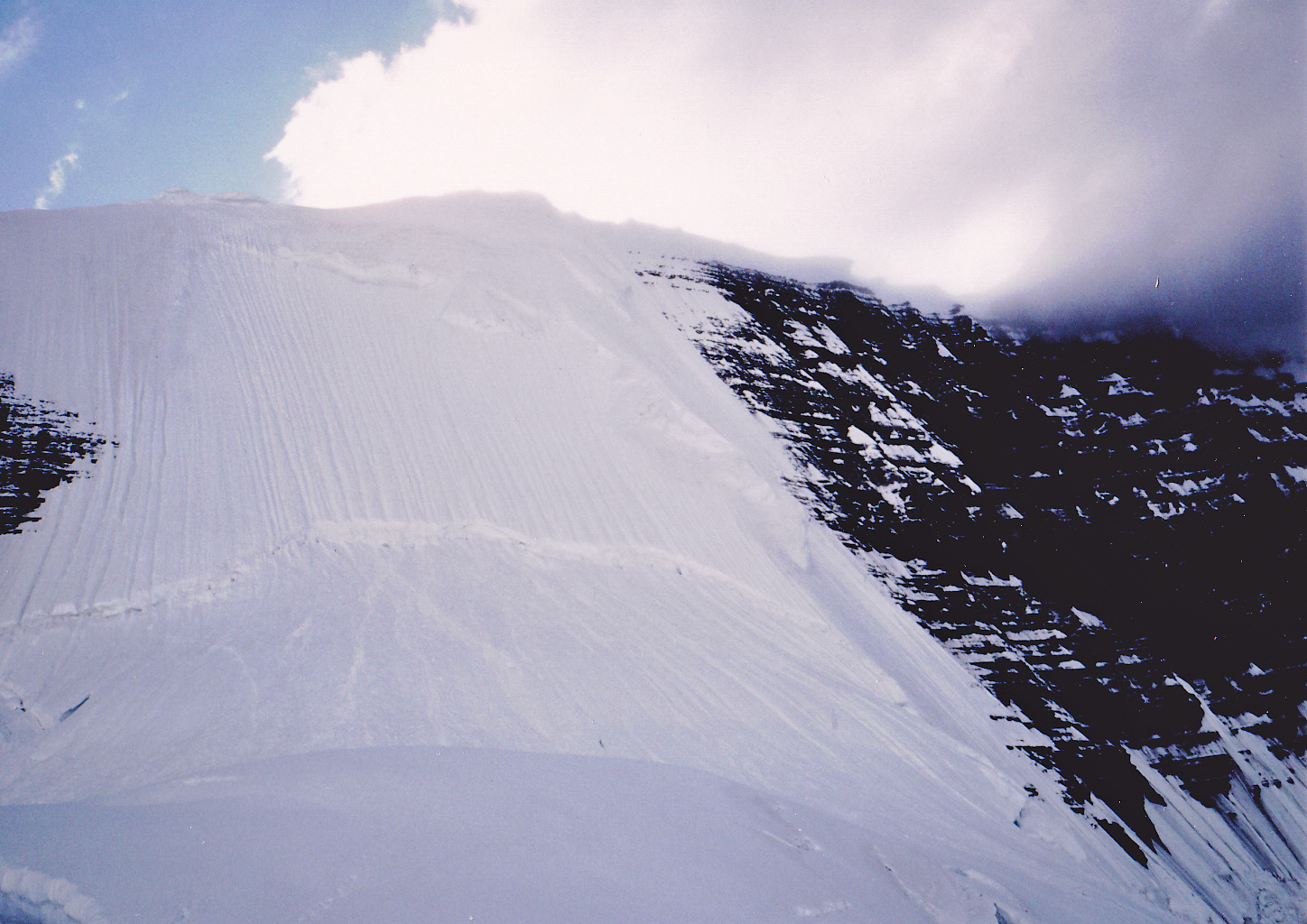
A steep face showing runnels.
Here is a close-up, where I’m standing amongst the runnels on that slope. They are from 12 to 24 inches deep. We were on our way back down – you can see our footsteps on the left side in the snow.
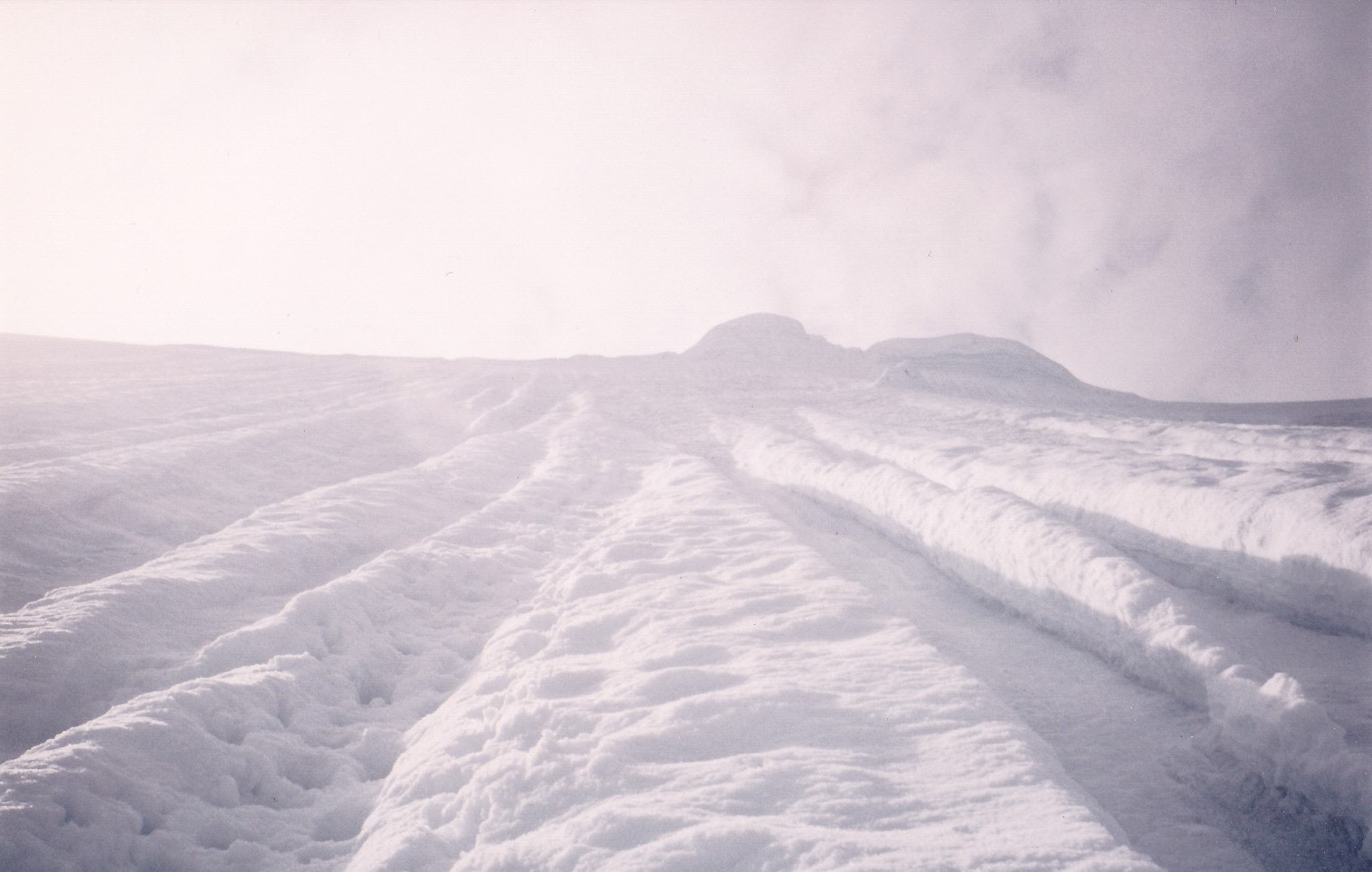
A close-up
Steep Slide
Three of us had just finished climbing two nice peaks that were side by side, and had made our way down to the saddle between them. Time had kind of gotten away on us, and we would soon lose the daylight. What could we do to speed things up to get back down to our vehicle? From the saddle, we could see all the way down to a small lake below. There was snow all the way down to the lake, with a few rock outcrops dotting the slope. Somebody came up with the brilliant idea that we could sit on our Gore-Tex rain jackets and slide down the slope, so we did. It was scary-steep, and once we got going we slid faster and faster, dodging the outcrops. In no time at all, we had dropped 600 vertical feet down to where the slope lessened and we came safely to a stop. But the slide itself was scary and heart-thumping. In retrospect, we were lucky we didn’t smack into one of those outcrops, because at the speed we were traveling, it would have been a bad outcome indeed.
Brewing Up
My guess is that British climbers are the ones who started the practice of stopping during the day’s climbing to fire up their stove, melt snow and brew some hot tea. Sometimes it was done in precarious places. I never did it myself – perhaps I was always in too much of a hurry, or didn’t really see the benefit in it. One time, though, I was climbing a peak in southwestern BC with 2 other fellows – it was October 3rd. One of them, Mike, had climbed with me several times in the past. This time, he had invited his friend Bob to come along with us. Bob wasn’t from those parts, and, as I recall, he wasn’t British – ahh, now I remember, he was from the US. Anyway, it wasn’t a big climb, the summit rising 2,000 feet above tree-line. It would have been an easy day-climb, but we’d started late. We climbed into the afternoon, and hadn’t been on the move but an hour when Bob announced that he wanted to stop and make a brew. It was a pleasant-enough day, temperature probably around 40 degrees F. and overcast – nice conditions as far as Mike and I were concerned. “Make a brew, what the hell for?” was our response. He said he was cold and tired. We told him to buck up and keep moving, because we weren’t going to stop. He reluctantly agreed, but a couple more times he said he wanted to stop and brew up. We told him to stop if he wanted, but we were continuing without him. He kept going with me and Mike. After 2 hours of climbing, we reached a meadow at tree-line at 6,200 feet. We all agreed to camp there. Mike and I dropped our gear there and headed on to the summit with day packs. There was an inch of fresh snow, and Bob decided to stay in camp. By 4:15, Mike and I were on the summit. When we returned to camp, it was 14 degrees F. Bob was able to make as many brews as he wanted until we left the next morning.
Tricky Summit Moves
It was the height of winter, and deep, fresh snow lay upon the land. Brian Rundle and I had worked our way up to within a short distance of the summit of Castle Towers Mountain. We had reached what appeared to be an impasse. A vertical rock wall blocked our path along the summit ridge. We couldn’t climb it. What to do? Hmmm, perhaps we could outflank it on the left side. It seemed our only option if we wanted to continue. The only gear each of us had were crampons and a regular ice axe. We roped up and I led out.
That first step really had my heart pounding. Clouds were swirling around us, and just as I set out, they parted to reveal the steep drop down to the 2,000 vertical feet of glacier below, Where I first stepped out, the slope was 60 degrees, but within a few feet of climbing, it steepened to vertical. There was a small cornice blocking my way, and as I approached it I knew I’d have to hack my way through it, which I did. That done, I crawled up through the gap I’d created and on to the flat surface above. What a rush!! I’d never done anything quite that bold before. Once I’d calmed down, I shouted down to Brian that I was ready to bring him up. He repeated the same moves, but without having to cut a path through the cornice. We then climbed together the remaining distance along the narrow ridge to the top – the clouds cooperated, allowing us enough of a view to prove we were on the summit.
When it came time to descend, we walked back down the ridge to the spot I’ve already described in such detail. We had already decided that we would not downclimb through the cornice and face – it was too scary a prospect. Instead, we stood at the top of the little face and wondered if we could jump down to the spot where we had roped up. It appeared to be a drop of about 12 or 13 feet. If we tried it, we would aim for a small platform, about a yard square and deep in snow. Perhaps we stayed roped together for a bit of extra peace-of-mind, but one by one we jumped off – it worked, the landing wasn’t too bad, and the hard part was over. The rest of the descent was a wallow through a lot of deep snow. That last part of the climb to the summit was memorable, for sure.
Bright Light
In early 2014, Mark and I decided to try something really bold – namely, to climb our way north through the Granite Mountains, picking off every peak along the way. To begin, I’d drop him off with all our gear and supplies at the southern edge of the range. I then drove 50 miles around to park at Charlie Bell Pass, east across the desert from the range itself. That evening, I contacted Mark by 2-way radio from where I was parked. It was 13 miles in a straight line between us. He was down on the flat desert, while I was parked 600 vertical feet higher, at the pass. We had a good radio connection, and decided to try an experiment. He had recently bought a Chinese climber’s headlamp which had a powerful beam. I asked him to turn it on, and lo and behold, I could see his light immediately. That was on the stronger setting, so I had him switch it to the lower-power beam – I could still see it, plain as day! I would have bet that it wouldn’t have been possible.
13 Stone
Recently, I was reading a story about a group of climbers attempting a Himalayan peak. The heaviest member of the team was having more difficulty, breaking through the snow crust and burning up a lot more energy than the others by doing so. He weighed 13 stone – I looked it up, that is 182 pounds. If he was the heaviest, the others must have been a fairly trim bunch.
Cartel Money
I spent decades climbing peaks within a hundred miles of the Mexican border. Mexican drug cartels operated throughout that area, at times seemingly with impunity. They played a never-ending game of cat-and-mouse with the Border Patrol. Dozens of times I came upon lookout spots high in the mountains, places where the amount of gear present showed that they would spend considerable amounts of time there. It was always a tense time being at one of those lookout spots, as you were never sure if cartel guys were lurking nearby and ready to perform mayhem on you. Usually I would just quickly pass by those spots, maybe take a picture, but keep on moving. One day I found a lookout spot high on a mountaintop, and because of the very open nature of the peak I could tell that there was no possibility of anyone hiding nearby. I rifled through all of the gear sitting there, excited that maybe I would find something of value. Well, I did – one US dollar – what a disappointment! Through all those years, I naively thought that maybe one day I would stumble across a backpack full of cartel cash abandoned or lost somewhere out in the desert. If I did, what would I do with it? Since it would be dirty money, ill-gotten gains from cartel drug activity, I decided that I would keep it. If I found a stash of drugs, of course I would report it to the Border Patrol right away.
Treading Softly
In the Himalayas of India, there is a mountain that is held to be sacred by the people who live nearby. It is feared and respected, and there is a saying among those who must travel past it: “Do not eat and do not speak until Shivling is passed.” Their respect is so cool.
Glacier Hole
In the summer of 1989, three of us were descending the Robson Glacier. It was the 11th day of an ill-fated attempt to climb Mount Robson. Like the vast majority of other climbers, the mountain had kicked our asses and sent us home empty-handed, taunting us daily with foul weather. As we neared the toe of the glacier, we came upon a spot where meltwater runoff rushed into a large hole in the ice. As we stood there, amazed at the power of the flow, we realized that if you were swept into the hole, you’d be lost forever beneath the ice and would certainly die. This photo shows the hole.
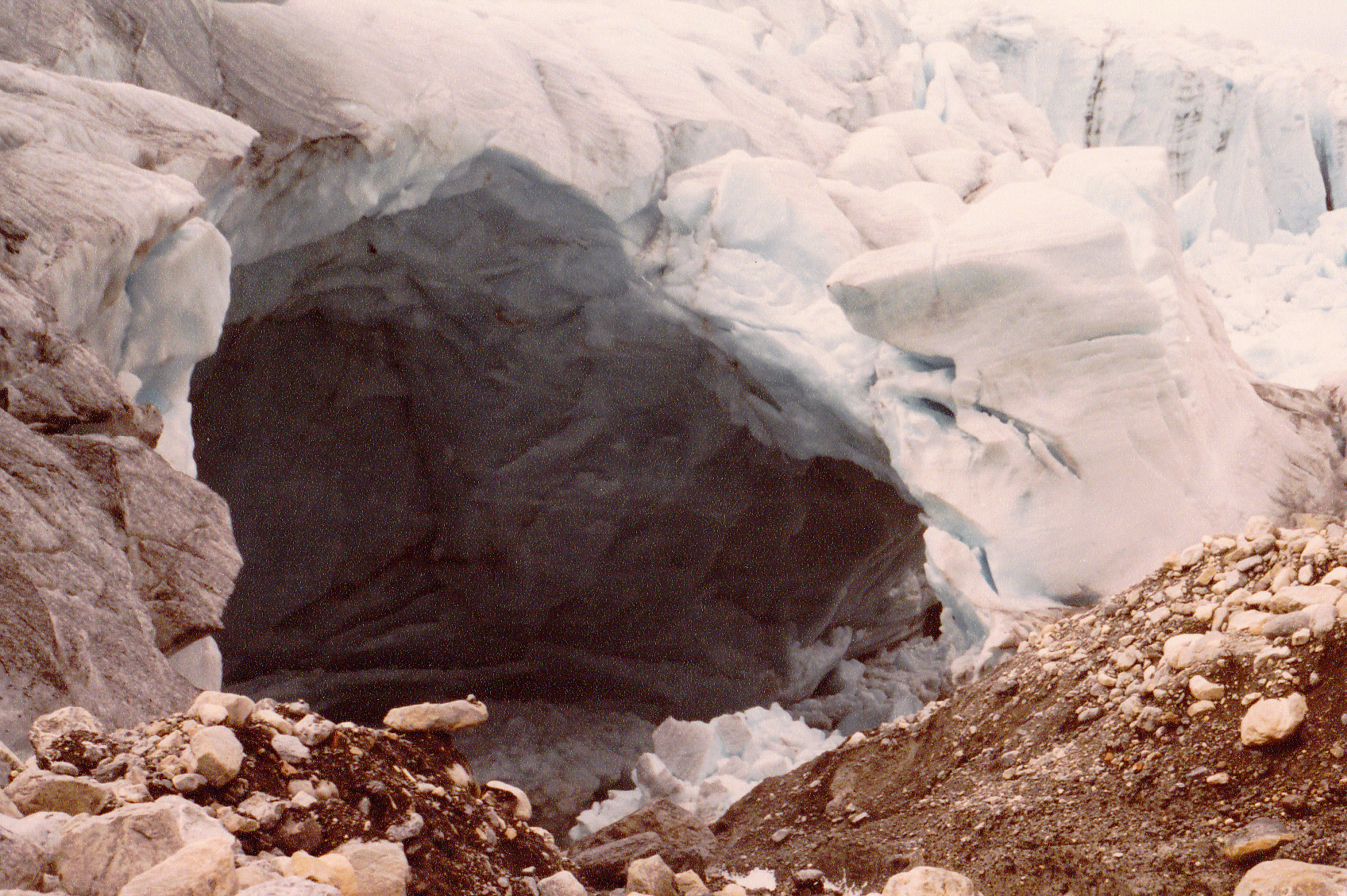
The hole in the glacier.
Love Those Names!
There’s a mountain range in Arizona that has some of the best names ever for its peaks, some of which are: Blue Plateau; Jack in the Pulpit; Slag Benchmark; Desolate Benchmark; Dragons Tooth. Great peaks, beautiful area.
Strong Tents
No matter how well a tent is made, no matter its design or its materials, in the end Mother Nature will destroy it. Load enough snow on it and it will collapse. Let enough ice form on it and it will tear. Strong enough winds can break the poles or tear its fabric. Yes, I’m aware that some of the newest tents are made of space-age materials and have frames that seem completely bomb-proof, but I still maintain that in the end, given sufficient time, Mother Nature will have her way.
Jello Drink
Back in the bad old days of winter camping and climbing, here’s something we tried as a drink. Melt snow in your pot to get enough water to make Jello. This was when Jello came in a little box which was mostly sugar, long before the days of artificial sweeteners. When the water was hot, you’d pour in the Jello and stir it well, then drink it as a hot drink. A good flavor, and tons of sugary goodness full of calories. Healthy, nope! But it tasted good and warmed your insides.