Québec Rides
I lived in the province of Québec for 4 years, from age 10 through 13. My parents allowed me a lot of freedom to explore the countryside around our town, and I used my bicycle to full advantage. There was nothing fancy about my bike, an old CCM one-speed, but by the same token there was little to go wrong with it. No gears to change, and no complicated hand brakes (it had pedal brakes). We lived in a small town a few miles outside of Montréal, and a ride of just a few minutes from my house found me in the very rural countryside of woodlands, open fields and small farms. Quiet paved roads wound their way from one small town to the next. Weekends were my time to explore, and that I did, and eagerly. Sometimes with a buddy, but usually by myself, I’d spend an entire day riding to a new village I’d never seen before. Our family was too poor to own a car, so I really held all the cards – my bike gave me a sense of power by allowing me to go where I wanted, when I wanted. My parents didn’t seem to care where I went, as long as I tried to be safe. My exploits took me to such places as Chambly, Boucherville and Sainte-Julie. Those were halcyon days indeed, just me and my trusty iron steed slowly making our way through the quiet countryside from one wonder to the next.
Beginnings
Did you ever stop to think about how you got into climbing in the first place? Now I suppose that would depend on what type of climbing we’re talking about – if it was rock climbing or ice climbing, it is most likely that you learned your craft from a partner who mentored you, someone with experience enough to teach you how to do it properly. Eventually, you knew enough to lead such climbs. If you were a peakbagger like me, then it’s entirely possible that you may have ventured out on your own, even at the beginning, and started exploring different ways to reach the summit of a peak. But even peakbaggers could benefit from being in the company of someone more experienced, someone who could share their knowledge of how to navigate and climb. I can’t speak for others, but I began life as a solo peakbagger, gradually learning the craft as I progressed from one peak to another.
Steepness of a Peak
One mountaineer may say to another “That peak was really steep!”, but what does that mean? How steep is steep? How can you possibly compare one peak to another when it comes to something like steepness? Isn’t that rather subjective anyway? Well, it turns out that there is a way to scientifically measure steepness and use that as a basis for comparison to other peaks. The website Lists of John gives this definition of how to determine a peak’s steepness:
Steepness is an average of the angles in all directions downward from the summit at a fixed distance of 100 meters using National Elevation dataset.
Here’s what that means. Imagine you are standing on the very highest point of a peak. Draw a line horizontally outwards from that point for 100 meters and then drop down vertically from that point until you hit solid ground on the mountain slope below. Measure the angle created by joining the high point on the summit down to where you hit solid ground below. Now do the same thing for an infinite number of other points of the compass, moving out 100 meters each time, then dropping down vertically to the ground below. Average out all of those readings and you can come up with a number that can tell how steep a peak is. Here is a fine example – this peak is found in Organ Pipe National Monument, and its name in the native O’odham language is I’itoi Mo’o. Of the 7,300 peaks found in Arizona, it is ranked as the 20th steepest of them all. It has an average steepness of 59.12 degrees. Of the 142,000 ranked summits in the USA, it is the 70th steepest of all of them. Pretty impressive, huh?
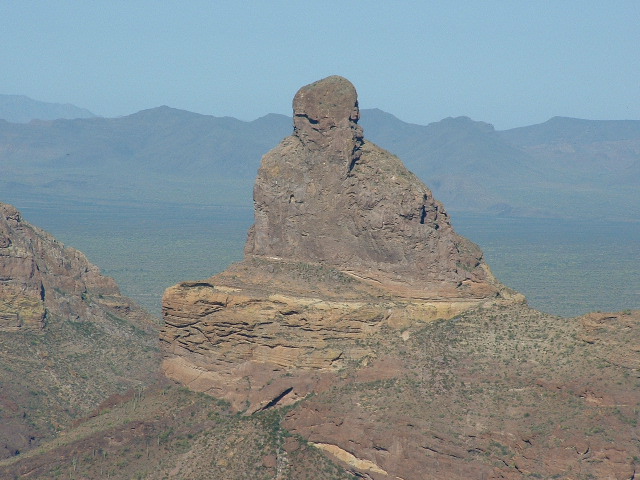
The east side of I’itoi Mo’o
Varying Footwear
Back in the 1970s, Ross Lillie and I did an amazing climb in a remote area of BC. For the first several miles, we wore our mountaineering boots as we walked along an old logging road. As the snow deepened, we switched to snowshoes for the rest of the day. The next day, still on snowshoes we trekked to the end of the road and then along a creek for a couple miles more. Next came a climb of 2,600 vertical feet, steeply straight up through the bush, still on snowshoes, until we emerged above tree-line. We camped there, but the next morning we set out on snowshoes again and continued to climb, gaining another 1,855 vertical feet. Finally, we reached the crux, a saddle where the most challenging climbing would begin. We roped up, removed the snowshoes, and strapped on our crampons. This last part of the climbing was up along a challenging ridge for 500 vertical feet. Have a look at this photo, and you’ll see why we switched to crampons. We climbed straight up the middle of the photo through all of the snow mushrooms.
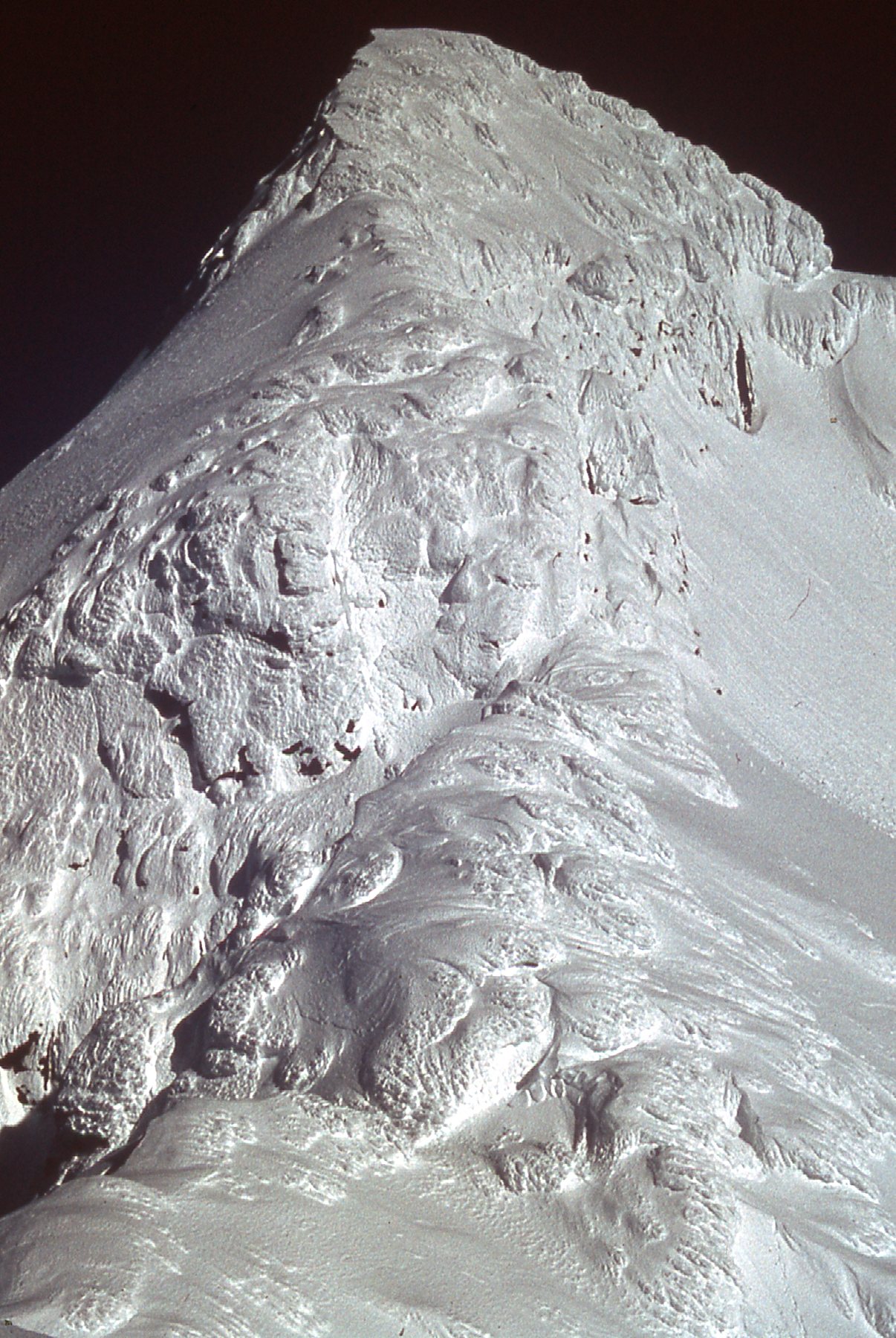
The west shoulder of our peak.
After we descended back down to the saddle, we climbed the west summit, still wearing crampons. Only once we were back down to the saddle did we put on the snowshoes again, and wore them the rest of that summit day back to camp, and then all of the following day back down to and along the old logging road. On our 5th day, after several more miles we took them off and walked in boots again. So, a little of everything as far as footwear was concerned.
Church Mountain
Way back in the bad old days, in 1977 to be exact, I was living in British Columbia just a few miles from the US border. It was easy work to make a short drive south to peaks in the North Cascades. That’s exactly what happened on November 16th – my intention was to drive in to the trailhead for Mount Baker on its north side. The weather had other intentions, however. The road that headed in already had too much snow on it to get very far, so a night was spent camping in the valley below. Plan B would take place the next morning. Although November 17th isn’t technically winter in that part of the world, you wouldn’t have known it. Snow lay heavily on the mountains, so I wasn’t able to drive too high on the old logging roads. Instead, my partner and I walked up the roads through the ever-deepening snow. At around 4,800′ elevation, he decided to call it quits and go no further. I was determined to continue, though, and I did. My notes from that day mention “So much snow!” It was slow going. I took this selfie en route. See the reflection of my ice axe in the glasses?
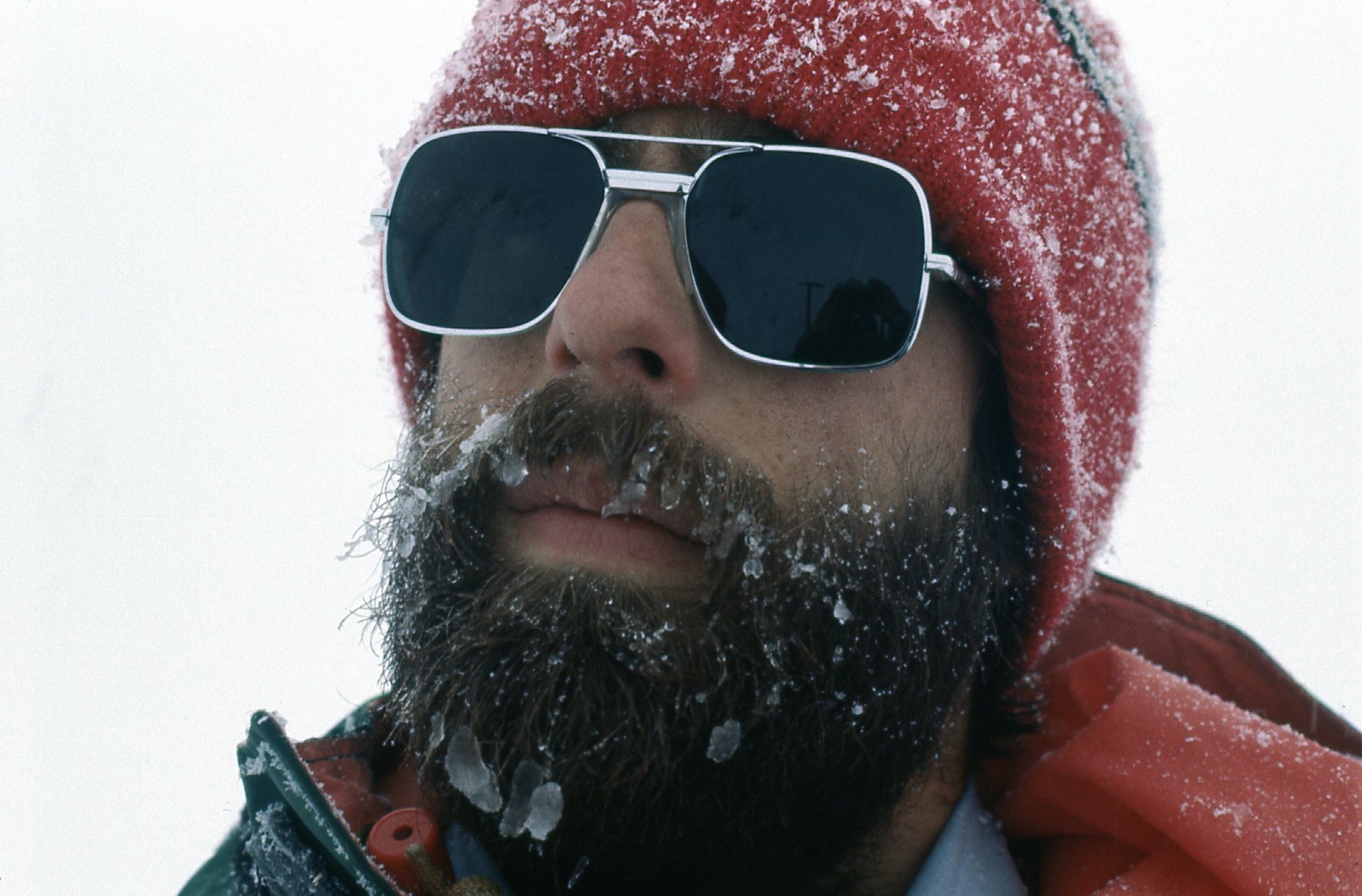
DM in winter
Here is a shot I took looking towards the summit in the crappy weather.
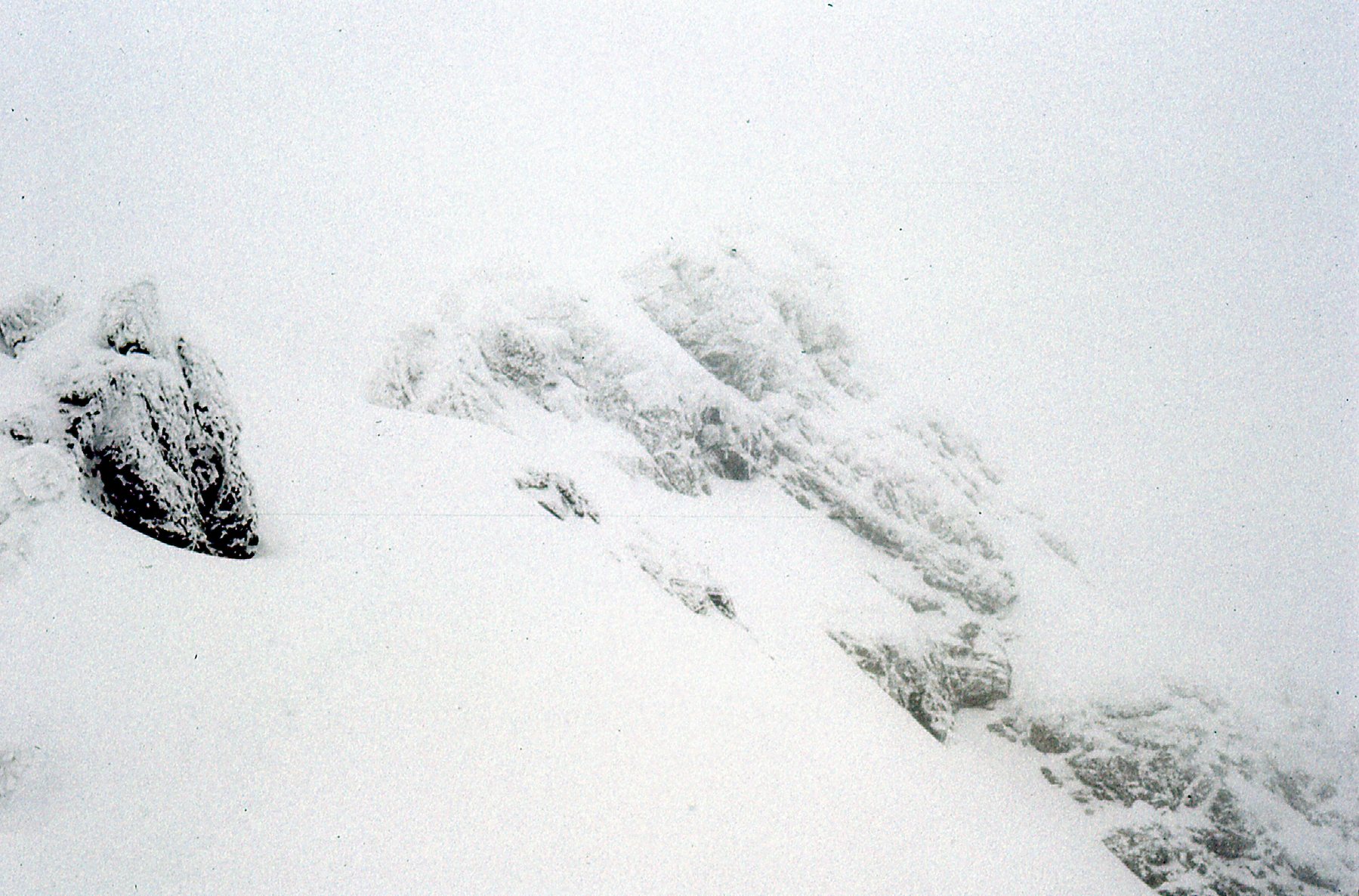
Close to the summit.
It took me 5 1/2 hours to get to the summit of Church Mountain. It was quite the ordeal. I was glad to be done, and that vehicle looked mighty good at the end – felt good too, with the heater blasting.
Crevasse
You don’t want to fall into a crevasse, under any circumstances. If you’re alone, it could be a death sentence, as it may be impossible to extricate yourself. Even if you’re with a partner, or several partners, you definitely don’t want to fall in, even if you’re roped up. There have been plenty of instances where someone fell into one and ended up being so tightly wedged in between the icy walls that even their partners couldn’t free them, no matter how hard they tried. I can’t imagine how horrible it would be to be wedged in one so badly that even rescuers couldn’t get you back out. In such a case, it’d be a blessing to be unconscious from the fall in. Being awake would be horrible too – by their very nature, crevasses are very cold places, and often quite wet. It’d be common to have water dripping on you, soaking you to the bone, while you became hypothermic until you lost consciousness and died. Many’s the time when other climbers had no choice but to give up trying to extricate someone who had fallen in. Some crevasses are so deep that others up top can’t even see where their friend has landed. Huge crevasses in Antarctica have swallowed up entire dog teams along with sled and driver, and even large pieces of equipment like snow cats. Brrrr – definitely the stuff of climber nightmares.
Tight Squeeze
One time when I was climbing in the Virgin Mountains of Nevada, I had to drive my Toyota pickup up a canyon which was scenic and also exciting. It narrowed so much at one point that I had serious doubts as to whether I could pass through and continue. My truck was an older model with a narrow body. I had a measuring tape with me, so I got out and measured the gap between the canyon walls. Then I measured the truck. The only way I’d be able to squeeze through would be if I were to fold the rearview mirrors in against the body of the truck. So that’s what I did, then inched forward ever-so-slowly. There was only 1-2 inches to spare on each side, but I made it without scraping the canyon walls. Whew! I completed my climb, but hours later when I had to return the same way, I was sweating bullets as I came to the narrow spot. Once again, I made it through without damaging the truck. I never tried such a stunt again – it wasn’t worth the stress.
Mt. Wilson Cluster
Back in 2003, I was visiting my friend Dave in Los Angeles. At the time, he was working at the Mt. Wilson Observatory. One morning, I drove with his brother-in-law up into the high country so we could climb a few peaks together. After parking in a good spot, we set out and climbed, in one big push, 5 different peaks before returning to our vehicle. In order, they were: San Gabriel Peak; Mt. Disappointment; Mt. Deception; Mt. Lowe; Mt. Markham.
We then drove further down the road and parked for Occidental Peak. It was a quick climb directly up from the road. To end the day, I was dropped off at Mt. Wilson, where I spent a while searching among the buildings until I found what was for sure the highest bit of ground. Later, I met Dave after his work and we drove back down to the city together. The day proved productive, with 7 peaks for the effort.
Scaredy-Cats on Norman Clyde
The summer of 1999 found me in the Sierra Nevada of California. I was camping with friends Brian, Dave and Carol. One morning, we went over to the base of the North-Northeast Ridge of Norman Clyde Peak, intent on climbing it by that route. The climb itself is rated Class 3-4 and is considered the easiest route from the east side. As we stood at the start of the climb, Carol was really excited to give it a go. She had been doing a lot of technical roped climbing lately, whereas we 3 guys hadn’t done any for a while. The 3 of us guys agreed that we were too chicken to proceed and decided that we wouldn’t give the route a try. Carol was disappointed, to put it mildly.
Huge Cone
Several years ago, while climbing Cuyamaca Peak in California, I saw a pine cone in the forest, or at least I think it was pine. Further research shows me that it is from a big-cone pine tree. I had never seen anything so big. I’ve kept it all these years. It is very hard, and the hooked tips are deadly. You can’t handle it without gloves.
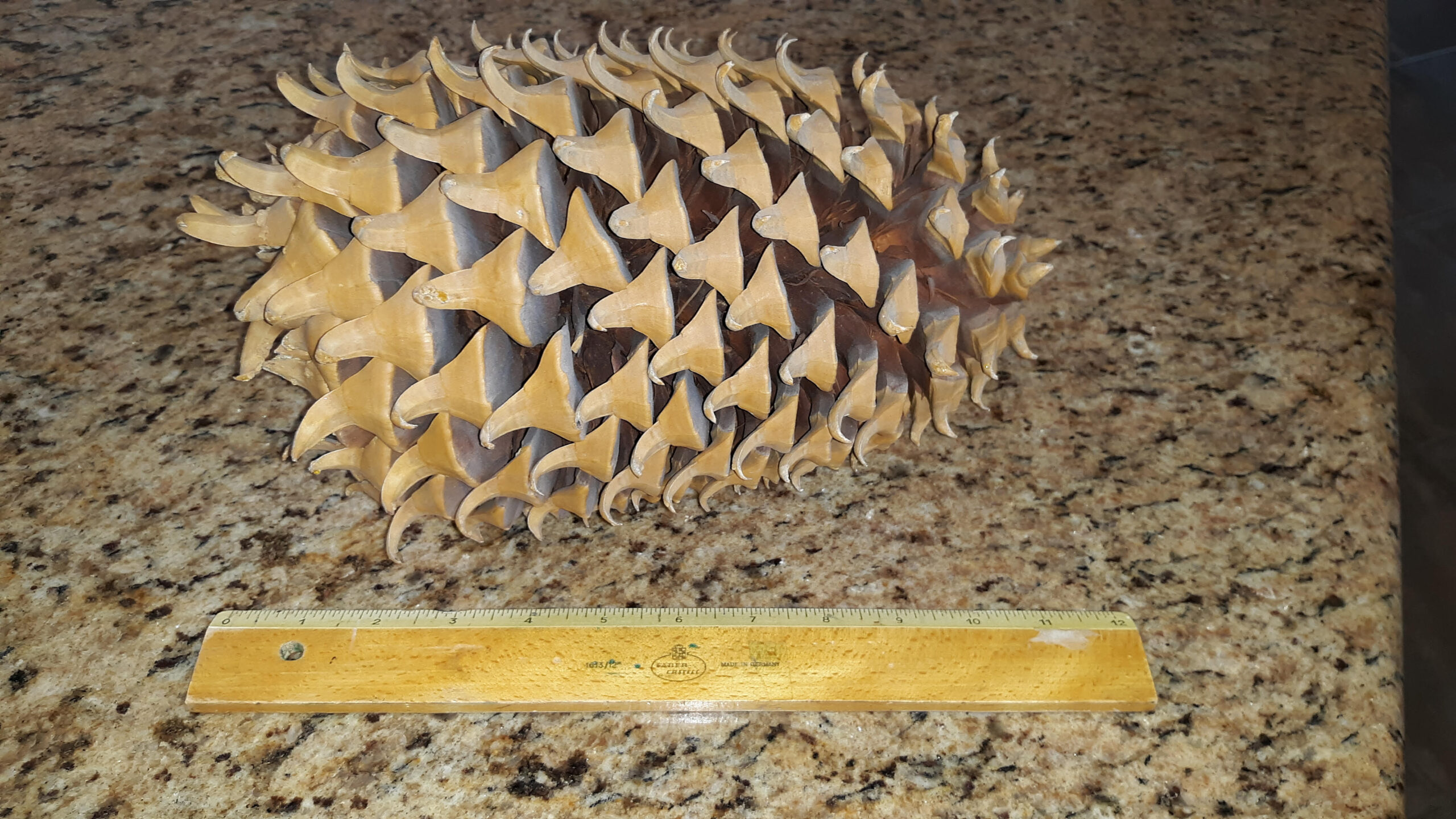
That’s a 12-inch ruler