
I thought it would be fun to write a piece about the animals that live here in Arizona. There are probably more of them than most people would think. Our topography is quite varied – everything from hot deserts to cool forests, and the variety of creatures that inhabit these zones is quite surprising. I wasn’t sure how to approach such a broad subject, but decided to start with the smallest creatures and work my way up to the largest.
Amphibians: Frogs and Toads: we have 5 species of tree frogs; one neotropical frog; one narrow-mouthed frog; 6 types of true frogs; 7 types of toads; 4 spadefoots; 1 type of salamander. Turtles: 2 box turtles; 3 mud turtles; 2 tortoises; 1 softshell turtle. Lizards: 1 alligator lizard; 1 gecko; 1 Gila monster; 3 collared lizards; 1 leopard lizard; 1 iguana; 1 chuckwalla; 26 various other lizards; 5 skinks; 11 whiptails; 3 night lizards. Snakes: we have so many types of snakes, 54 of them in fact – I won’t list them all, but just some of the major groups: boas; sandsnakes; whipsnakes; racers; nightsnakes; kingsnakes; milksnakes; gophersnakes; ratsnakes; black-headed snakes; gartersnakes; coral snakes; threadsnakes; sidewinders; 15 rattlesnakes, all of which are venemous. Here is an excellent website which will tell you everything you’d ever want to know about these creatures.
Small mammals: Mice – 4 types of pocket mice, and 4 others; Rats – 4 types of kangaroo rats, and 3 others; 1 type of shrew; 1 type of pocket gopher; 1 type of chipmunk. Squirrels – we have 4 species and 8 subspecies, and they fall into 2 basic groups: tree squirrels, found at higher elevations and in forests; ground squirrels, found in rocky areas and deserts.
Bats: Arizona has more species of bats than any other state except Texas, a total of 28 different ones, which represent 4 different families and are found across all habitats, from the low Sonoran Desert to high-elevation pine forests. They are divided between insect-eaters and nectar-eaters.
Rabbits: in Arizona can be found 3 types (think cute little cottontail bunnies) – desert cottontail, found throughout the state in desert brush and suburban areas; mountain cottontail, found in elevations above 7,500 feet; eastern cottontail, usually found in areas with more cover.
Hares: we have 2 types in Arizona. One of them is the elusive Antelope Jackrabbit. They are supposedly abundant, but in 40 years of desert wandering, I don’t think I’ve seen more than 5 of them. See the white rump.
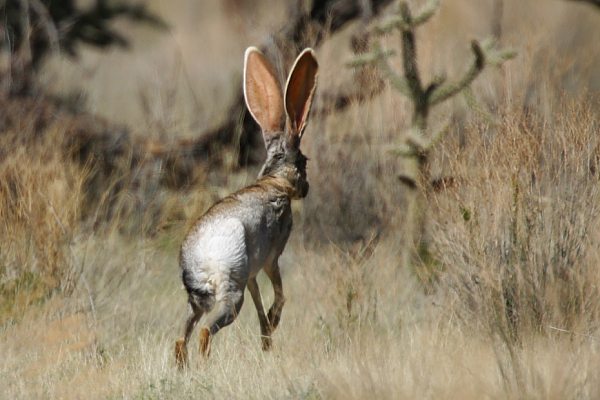
Antelope Jackrabbit. This picture is courtesy of photographer Robert Shantz.
The other one is the oft-observed Black-Tailed Jackrabbit.
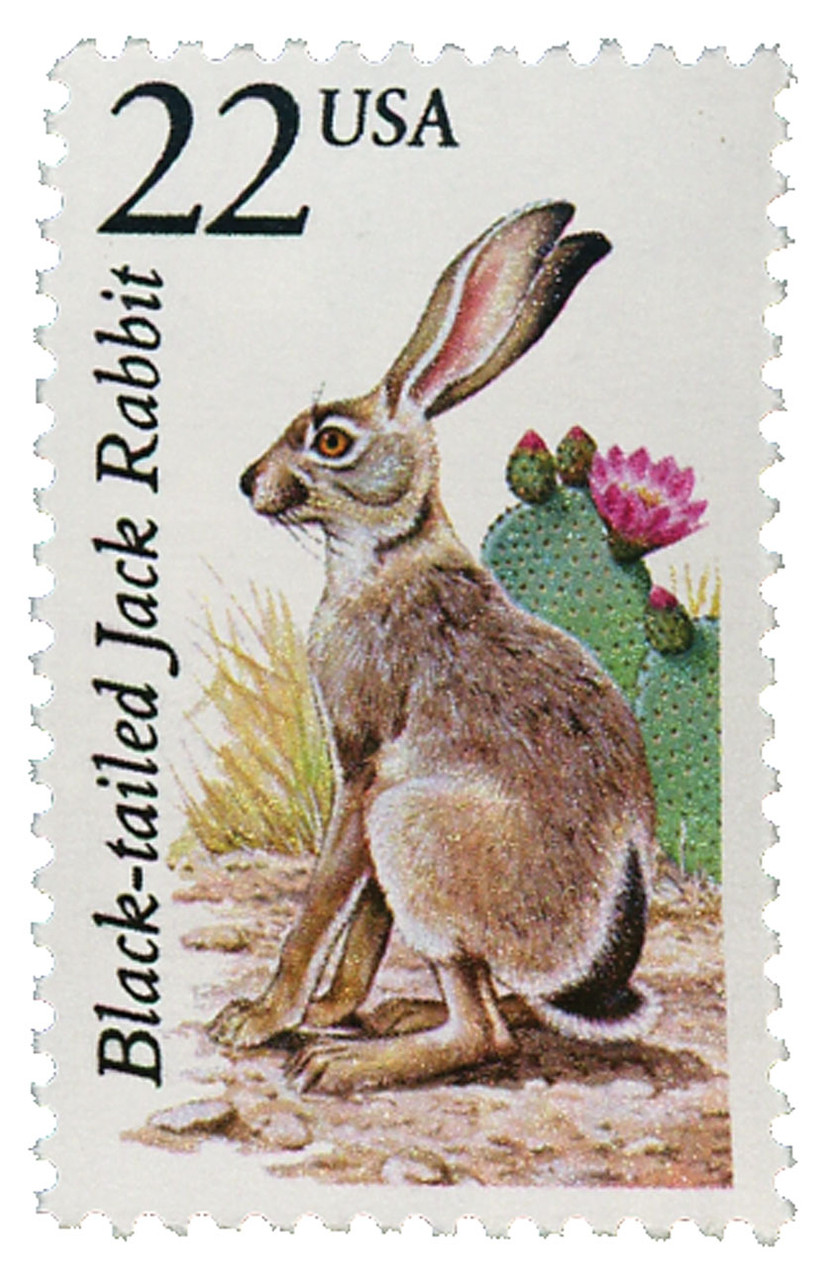
Ferret – endangered in Arizona, we have the black-footed ferret. It is North America’s only native ferret.
Prairie Dog: Black-tailed prairie dogs are found in southeastern Arizona grasslands. Gunnison’s prairie dogs inhabit the northern part of the state.
Badger: the American badger is found throughout the state. Nocturnal, elusive, I have only ever seen one of them.
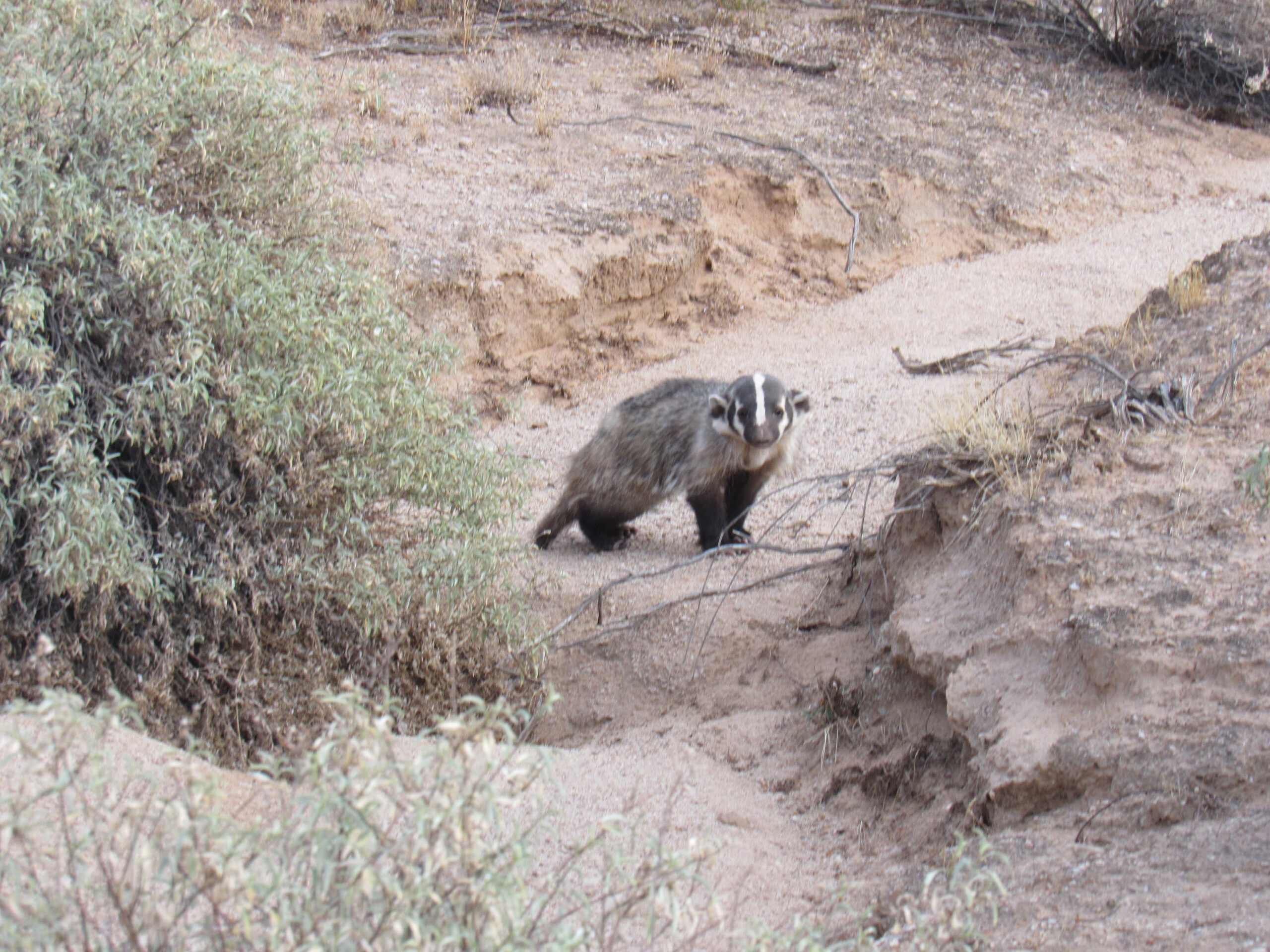
Seen in 2019 in the Maricopa Mountains.
Beaver: native to Arizona, they are uncommon, and found in riparian areas.
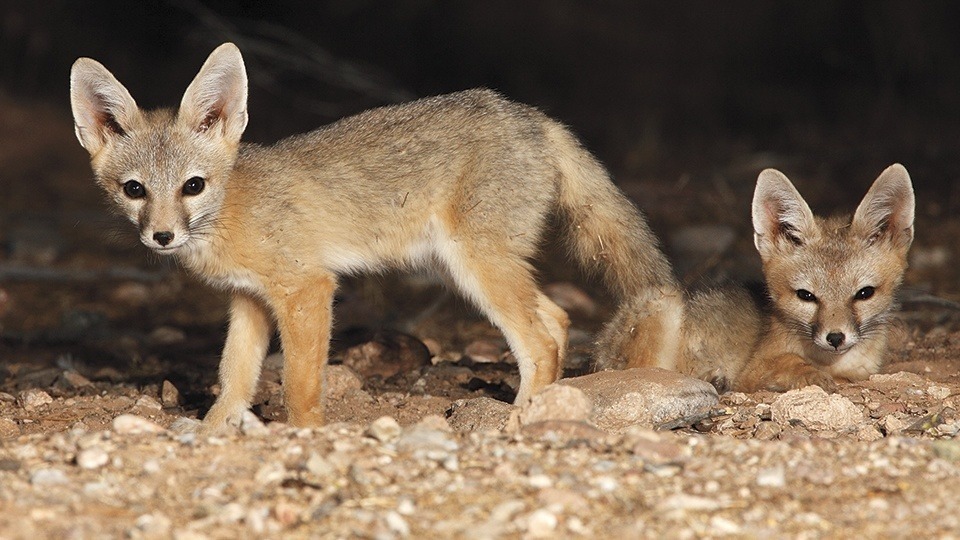
Fox: 3 types are found in the state. The Gray Fox is the most common and widespread. They are typically found in rocky canyons, wooded areas, and rim country. They are able to climb trees! The Red Fox is rare, and is most likely to be seen in the northern part of the state and in higher elevations. The Kit Fox is the smallest of the three, typically weighing less than 5 pounds. They are true desert dwellers with outsized ears that help dissipate heat and locate prey like kangaroo rats. They prefer open, sandy desert flats where they live in underground dens. This photo shows them.
Skunks: we have 4 different species in Arizona – the spotted skunk, the striped skunk, the hooded skunk and the American hog-nosed skunk. This site shows them well. I think they are fascinating creatures.
Ringtails: this is the official state mammal of Arizona. They have got to be the cutest damn creature you’ll never see. They are nocturnal – I’ve only seen 1 or 2 of them in 40 years.
Racoons: they are native to Arizona. A couple of months ago, we saw one in our back yard here in the middle of the city. Here’s a link to a site about them.
Coatimundi: these guys are common in Arizona. In fact, they range widely all the way down to South America. They can be seen in woodlands in southern Arizona where I live. Here is a site that gives a lot of info about them. They will raid bird feeders for the seeds. They are related to racoons and ringtails.
Coyotes: this has to be one of our most common animals found in the wild. They are everywhere, from Panama north through Central America, Mexico, all of mainland USA, all over Canada and well into Arctic areas. This site will tell you everything there is to know about this versatile creature. They have adapted well to humans and are found in cities everywhere. Packs of them roam freely throughout my home city of Tucson, and they can often be heard singing in chorus at night.
Javelina: also known as the collared peccary, these animals are common in parts of Arizona. They are generally found in bands of 8 to 15 animals of various ages. They defend themselves if they feel threatened, but otherwise tend to ignore humans. Groups of them roam sometimes at night through neighborhoods, upsetting garbage cans to feed on the contents. Once we left our garage door open and found 13 of them inside looking for whatever they might eat. This is an excellent site to learn about these creatures.
Birds: a great many species can be found in our state, but I want to focus on just a few of the larger ones here. Vultures: the most common type seen in Arizona is the turkey vulture. These birds have a 6-foot wingspan and can be seen throughout the state. Some people think that they are rather creepy and disgusting, but the service that they perform (eating dead creatures) is important. They range from southern Canada to the southern tip of Patagonia. We also have black vultures, easily seen in the southern part of the state. They are not quite as big or common as our turkey vultures. Another large bird that occurs here but is uncommon is the crested caracara. And then there is the California condor. This bird was brought back from the brink of extinction – from 27 individuals in 1987, to a present population of 565. This was accomplished by capturing the 27 and then managing a captive breeding program for many years to increase their numbers. Individuals have been returned to the wild and some can now be found in northern Arizona. I was lucky enough to see a pair of them several years ago. Eagles: we have 2 species that are native our state. The bald eagle can be seen here, and is always an exciting sight. We also have golden eagles. I have seen this large raptor many times up in mountainous country in Arizona. Another large bird that can be seen in Arizona is the wild turkey. The variety that is usually found here is the Merriam’s wild turkey. They are found in mid-to-high elevation ponderosa pine forests. It is a beautiful bird and always a delight to see, usually in flocks. One bird that was native to the state but hunted to near-extinction many years ago was the thick-billed parrot. Sadly, they haven’t been seen in Arizona since 1938, and are now found only in the Sierra Madre Occidental of Chihuahua and Durango in Mexico.
Cats: our state is blessed with several species of wild cats. Perhaps the best known would be the mountain lion. They are common across Arizona with an estimated population of approximately 3,000 and they are not listed as endangered or threatened. These elusive cats, also known as cougars or pumas, typically inhabit rocky canyons and mountainous areas, relying on deer as their primary prey. While generally avoiding humans, they may appear in residential areas seeking water or food, particularly at dawn or dusk.
Wolf: we have the Mexican wolf here in our state. Once common, they were trapped and hunted almost to extinction, but a captive breeding program coupled with release has allowed their population to expand to about 300 individuals in the wild. I was lucky enough to see one in the White Mountains a few years ago.
Deer: Arizona is home to two primary deer species: the widely-distributed mule deer, found from deserts to high mountains, and the smaller Coues’ white-tailed deer, which inhabits southeastern mountains and higher elevations. They are both abundant and are considered a major big-game species. You wouldn’t think they could survive in our low, hot deserts but they do.
Bears: the American black bear is native to our state, but its range is now limited to wooded and mountainous areas. It is estimated that as many as 3,000 of them live in Arizona. They sometimes come down from the mountains into the city of Tucson in search of food.
Pronghorn: this is the proper name of what we casually call antelope. We have 2 kinds of them here in Arizona. The American antelope is primarily found in Northern Arizona’s plains, grasslands, and in high-elevation meadows. We have about 10,000 of these animals. They are the fastest North American mammal, capable of reaching almost 60 miles per hour for short distances, and able to maintain 30-40 mph for long distances. And then there’s something really special to tell you about – the highly endangered Sonoran Pronghorn Antelope. Their numbers had dropped all the way down to 21 individuals in 2002, but then a captive breeding program was set up and carefully managed. Now, there are an estimated 450 in the wild, but their habitats are very threatened due to human activity. I have been very lucky to have seen them on 4 different occasions. Definitely check out the link to learn about them.
Horses: here in Arizona, there are a few wild herds of horses. These free-roaming unbranded mustangs often descend from Spanish horses from as far back as the 1600s. There are an estimated 500 of them today.
Burros: there are over 6,000 wild burros in Arizona. They are descendants of donkeys brought by Spaniards in the 1500s and also those used by miners in the 1800s. By law, these animals are protected. I have often encountered them in the desert, and have often heard them braying at night.
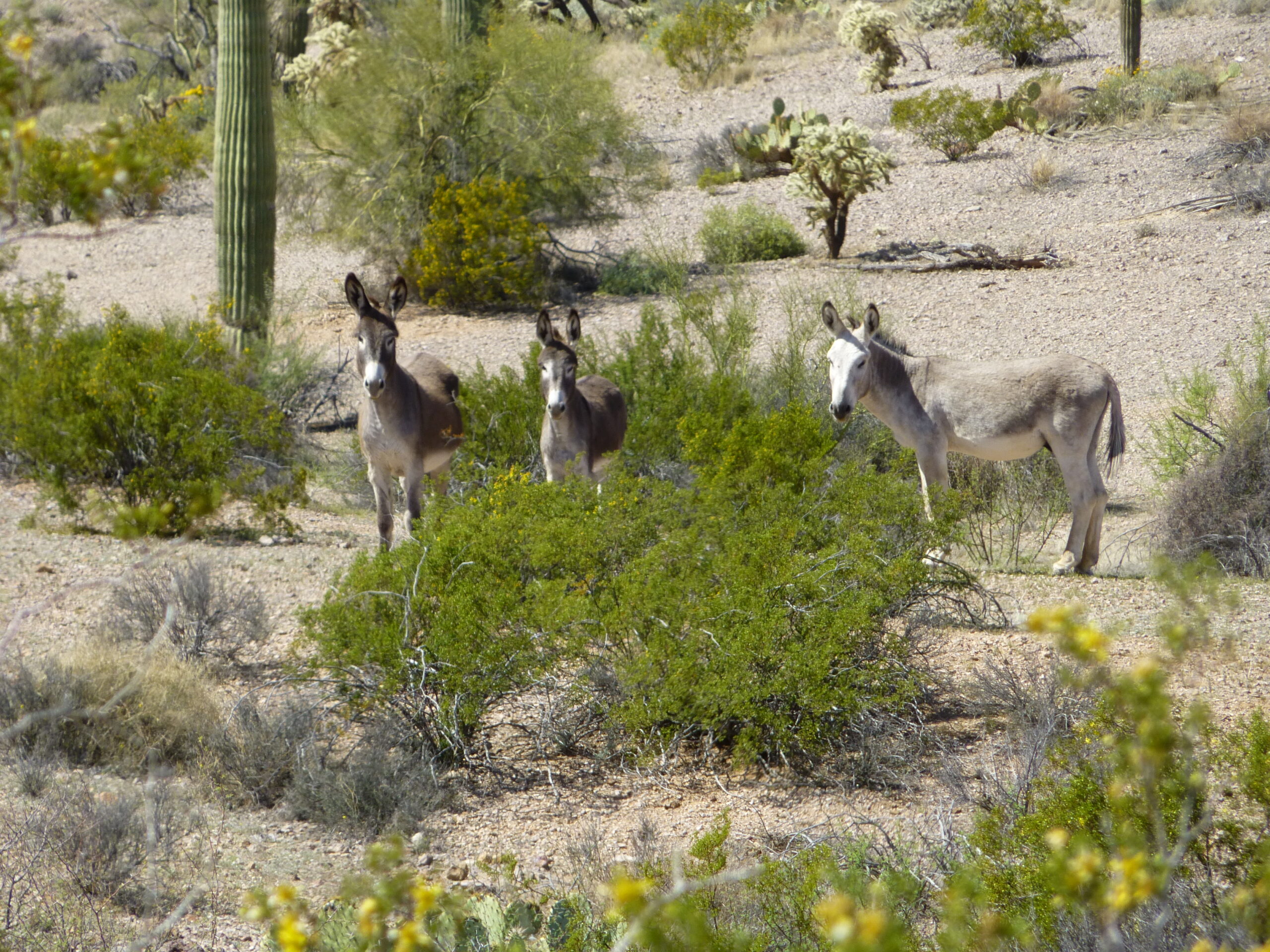
Cattle: there are no truly feral cattle but rather domestic animals that have escaped or been left on open ranges and have adapted to living without human contact. Arizona’s open-range laws allow cattle to roam freely, which can lead to cattle in unexpected, sometimes suburban, locations.
Bighorn Sheep: we are fortunate to have 2 different species in our state. The Rocky Mountain bighorn occupies the eastern and northern parts of the state, and currently number about 1,300 individuals (this is the same animal that is found in Canada’s mountain regions). Then there are the Desert bighorn, with about 5,600 animals – they are found in rugged, dry canyons in western and southern Arizona. I’ve personally only seen the desert species, and it’s always a special treat.
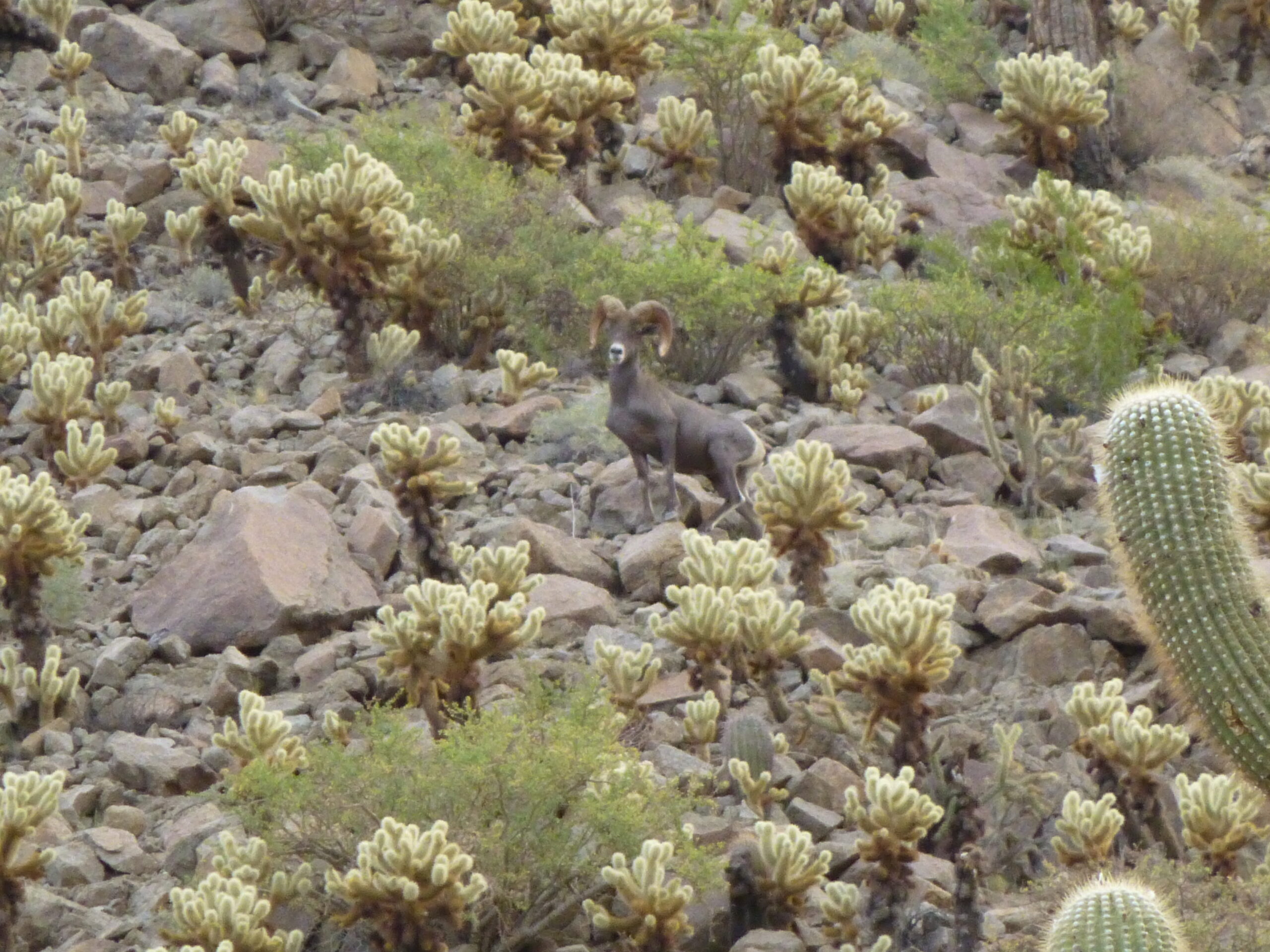
This desert bighorn was seen in the Agua Dulce Mountains about a mile from the Mexican border.
Elk: these large creatures are found in pine forests, juniper woodlands, and grassy meadows, typically at elevations of 5,000 to over 10,000 feet. Elk can also be found in smaller numbers in southern Arizona, such as in the Pinaleño Mountains. There are about 35,000 individuals in the state. They are commonly seen in northern Arizona. Most of them are Rocky Mountain elk descended from animals transplanted from Yellowstone National Park in the early 1900s.
Bison: last but not least we have the American bison, a species native to the state.
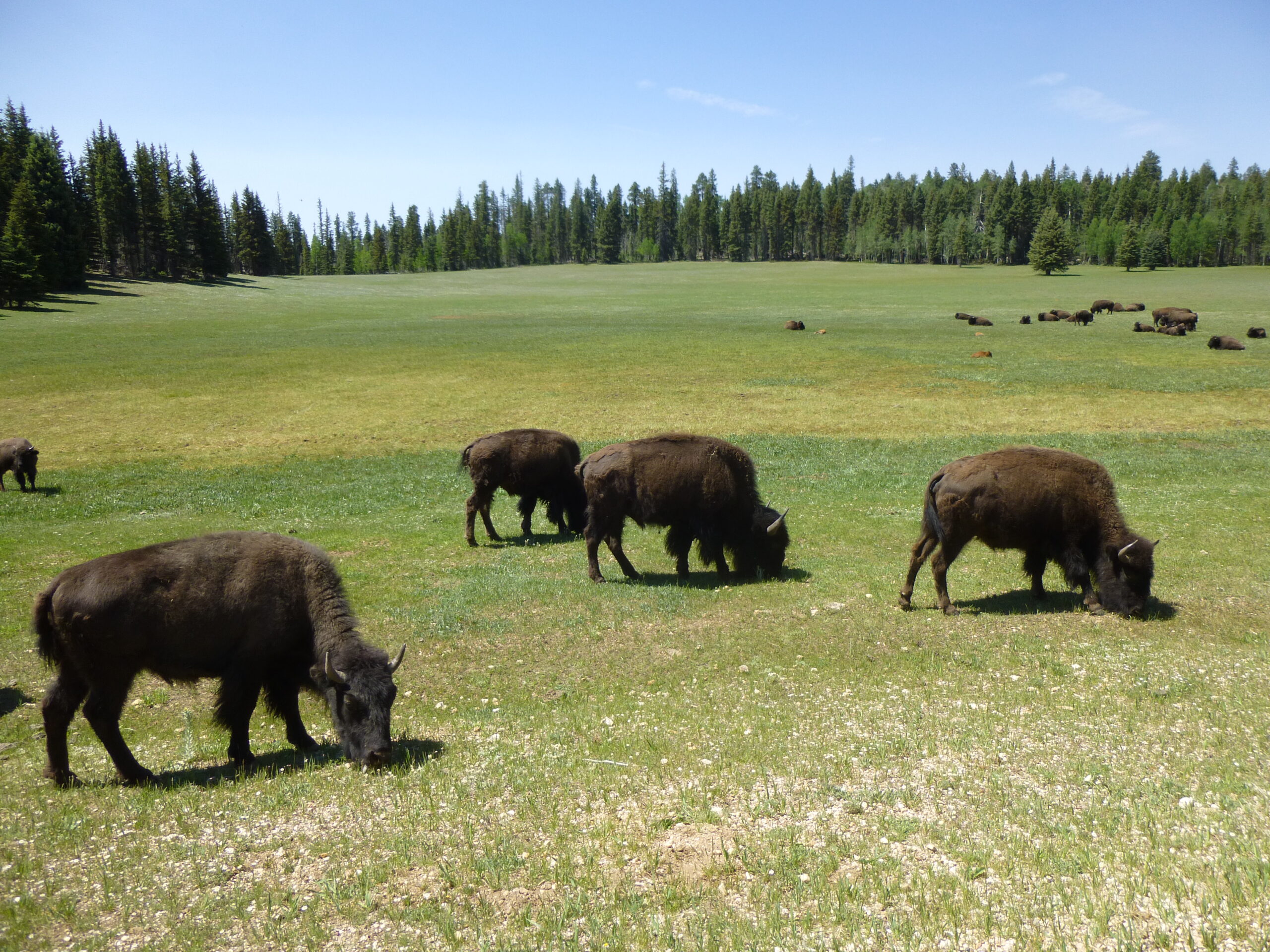
Bison on the Kaibab Plateau at an elevation of about 8,500 feet.
They are found in only a few locations, with a total number of individuals of about 400. They are most easily seen on the Kaibab Plateau on the north rim of the Grand Canyon.
So there you have it, folks, my roundup of the major animals to be found in Arizona. I think some of them may surprise those of you who live elsewhere.