
Howdy, Folks. Today I’d like to talk about one of my favorite things having to do with climbing mountains – registers. Here in the USA, and in Canada too, it’s common to leave some sign of your having summited. Most frequently, that takes the form of a glass jar with a tight-fitting lid. Inside the jar will be a piece of paper, or a little book, and a pencil. When you reach the summit, you find the register, open it up and sign in. This custom has been around for a long time, a century or more. I’ve also learned that in some countries, you may find a rubber stamp and a pad inside the container with which to stamp your climbing log to show you were there. In my country, the register is often placed by the first person to climb the peak. Some often-climbed peaks will have log books that are changed from time to time by a club when they are filled up and ready for a new one.
An important aspect of a summit register is that it must be impervious to whatever the weather may throw at it. Rain, snow, heat, cold, it must especially be waterproof. Another important ritual is the summit cairn. You don’t want to leave the glass jar lying out in the open, exposed to the elements. It’s best to build a mound of rocks around it, done carefully so you don’t crush the jar, enclosing it so the cairn leaves a space inside in which no rock is touching the jar. Maybe resting gently on the lid is okay, but gently being the operative word. A summit cairn is something with which many visitors to mountaintops are familiar – to non-climbers, probably more so than a register. Some cairns are huge, like this one left by an early survey party. It stands 6 feet tall. Brian Rundle and I once built one on a remote summit in Canada that was even taller.
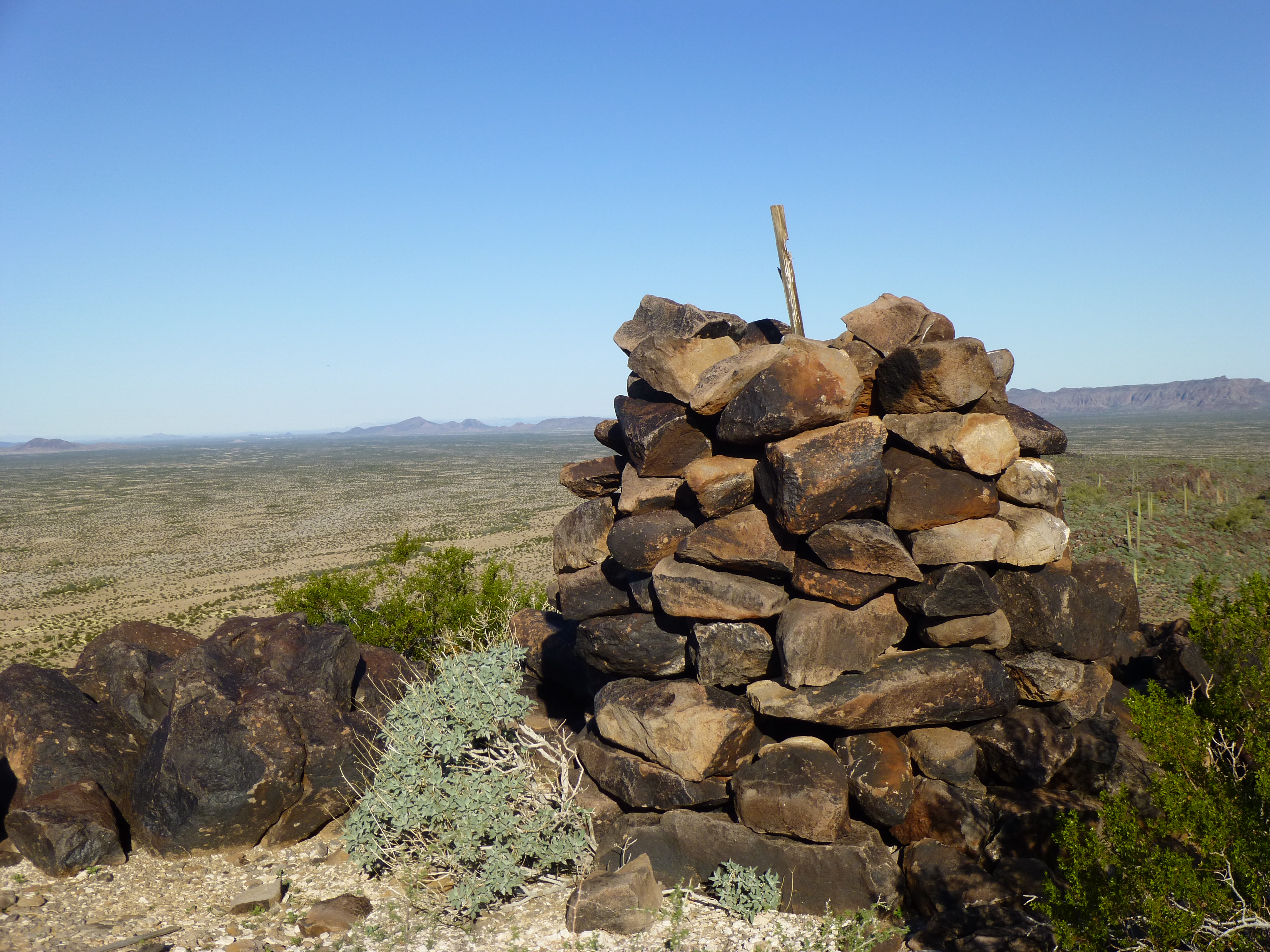
One big cairn
For climbers, the cairn not only protects the register, but also serves to draw your attention to where the register is located. Climbers will always, upon arriving at the summit of a mountain, look for the register. That way, they can sign in and also see who else has been there. On some peaks, the register may be well-hidden. That is more likely where it may be removed or destroyed by others who don’t want it to be there in the first place. I know of instances where the military has destroyed a register; ditto for tribal members on Indian reservations, or property owners on private land. Sometimes a register will be removed by government employees on Federal lands (like a national park or monument) or State lands. That’s why peakbaggers will search carefully for a register on a summit – it may not be really obvious. Some of those I’ve left have been well-hidden – I know peakbaggers will likely look for it and find it, where more casual visitors won’t. A significant problem on peaks near the border with Mexico is Bad Guys removing or destroying registers. In recent years, I’ve seen this dozens of times, and it’s always disheartening. A summit register is a piece of history and should be respected. If I visit a “border” peak and see that a register has been removed, I usually won’t leave another in its place, as I know it too will soon be destroyed. Many years ago, I was informed, in no uncertain terms, that climbers were not to leave their own registers on the summits within Organ Pipe Cactus National Monument. There were a few peaks where “authorized” registers had been left for climbers to sign in, but they were not more than half a dozen. Yeah, right – I can safely say that virtually all of the 50-odd peaks in OPC now bear registers left by a variety of climbers.
On a stealth climb, it may be advisable to sign in more anonymously – perhaps just put the date, but not your name or the city you’re from. Some climbers will use a pseudonym in such cases, one known to the climbing community but not to the general public. It’s not just climbers who will sign in to a register. Some of the entries I’ve seen have included: hunters, government workers, geologists, prospectors, tribal members, property owners, undocumented border-crossers and Border Patrol. I have also found terracache information on summits, but those folks seem to prefer leaving their own registers.
A register is a place to also leave a comment, and many of those who sign in do just that. Anything goes, whether it be positive, negative, spiritual or even R-rated. The entry may include information about the route taken to get to the summit, or the weather conditions that day, or other things observed along the way. I’ve seen nasty comments written by property owners, warnings to not cross their land under threat of prosecution.
Some old registers have deteriorated – water may have entered and left the paper a soggy mess, or mold may have blackened it. It’s not uncommon for a climber to leave a new, better register to replace the old one. Sometimes the old contents will be left in the new jar along with the new paper. Often, any legible information from the old paper will be written on the new, so that the historical record is maintained and credit is given where credit is due. Here is an example of that.
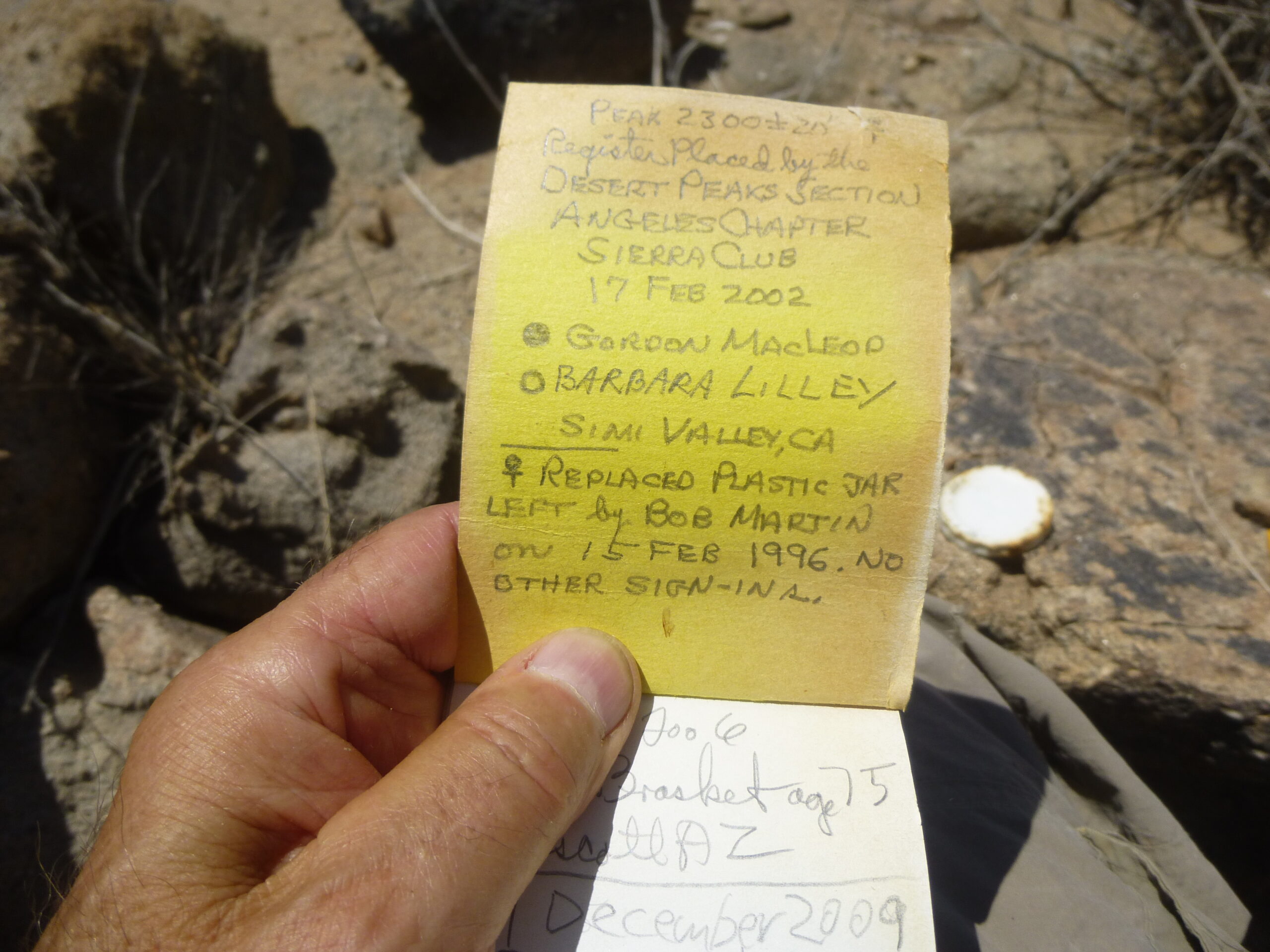
A register that has replaced an older one.
Let’s have a look at some of the types of registers that are used here in North America. The most common would have to be the glass jar. On a lengthy climbing trip where many peaks are to be climbed and probably for the first time, a lot of registers will need to be carried. Their total weight can really add up, so smaller jars can suffice. Here’s an example of the glass jar register taken to one extreme. It was not likely that anyone would ever climb this peak a second time (remote, dangerous, off-limits) so the bit of paper inside would be enough. Being water-tight is the most important thing.
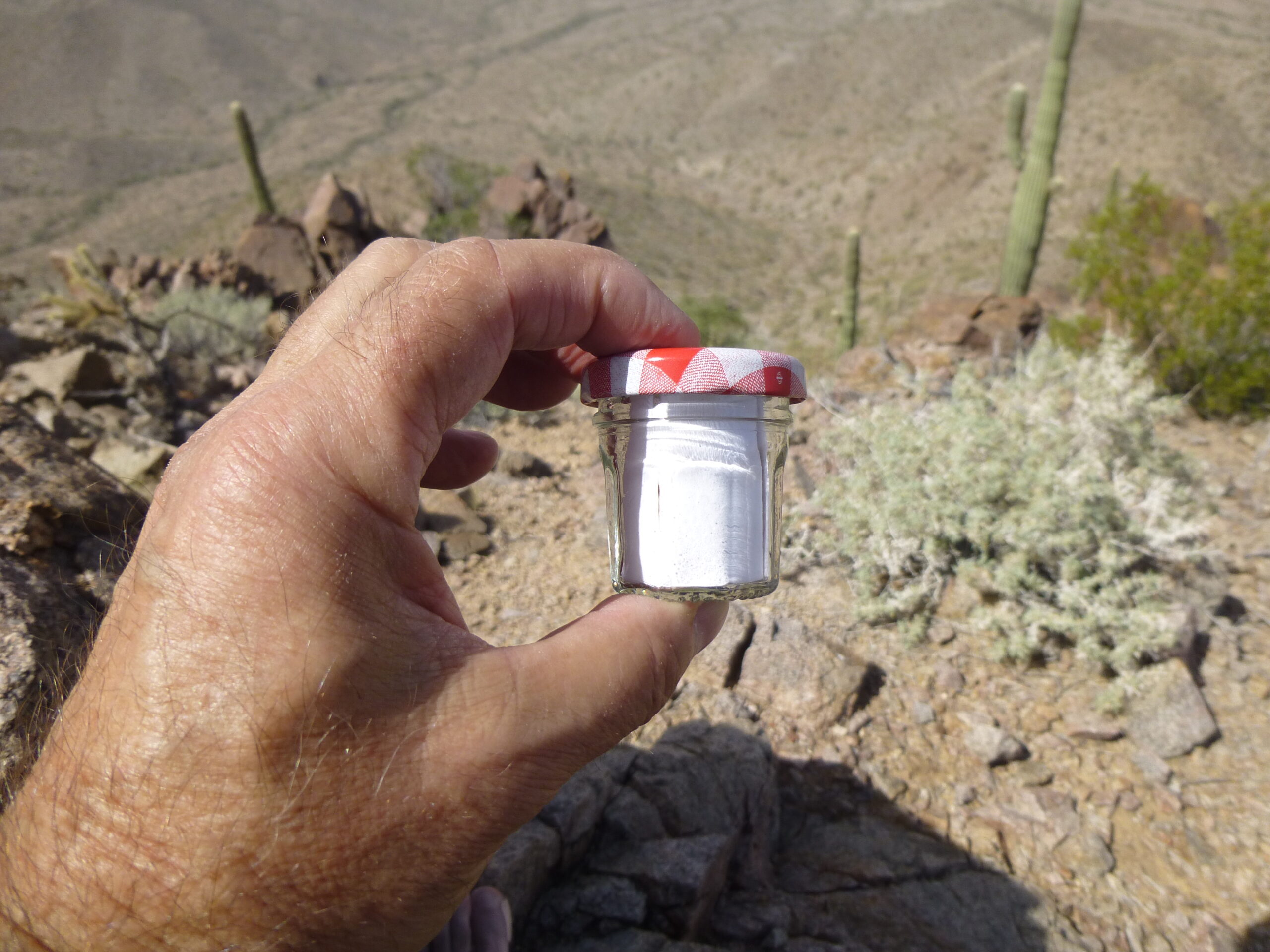
Inside this tiny jam jar is a slip of paper and a short pencil.
Even a really big jar will work, like this one. Only practical if you don’t have to carry it very far.
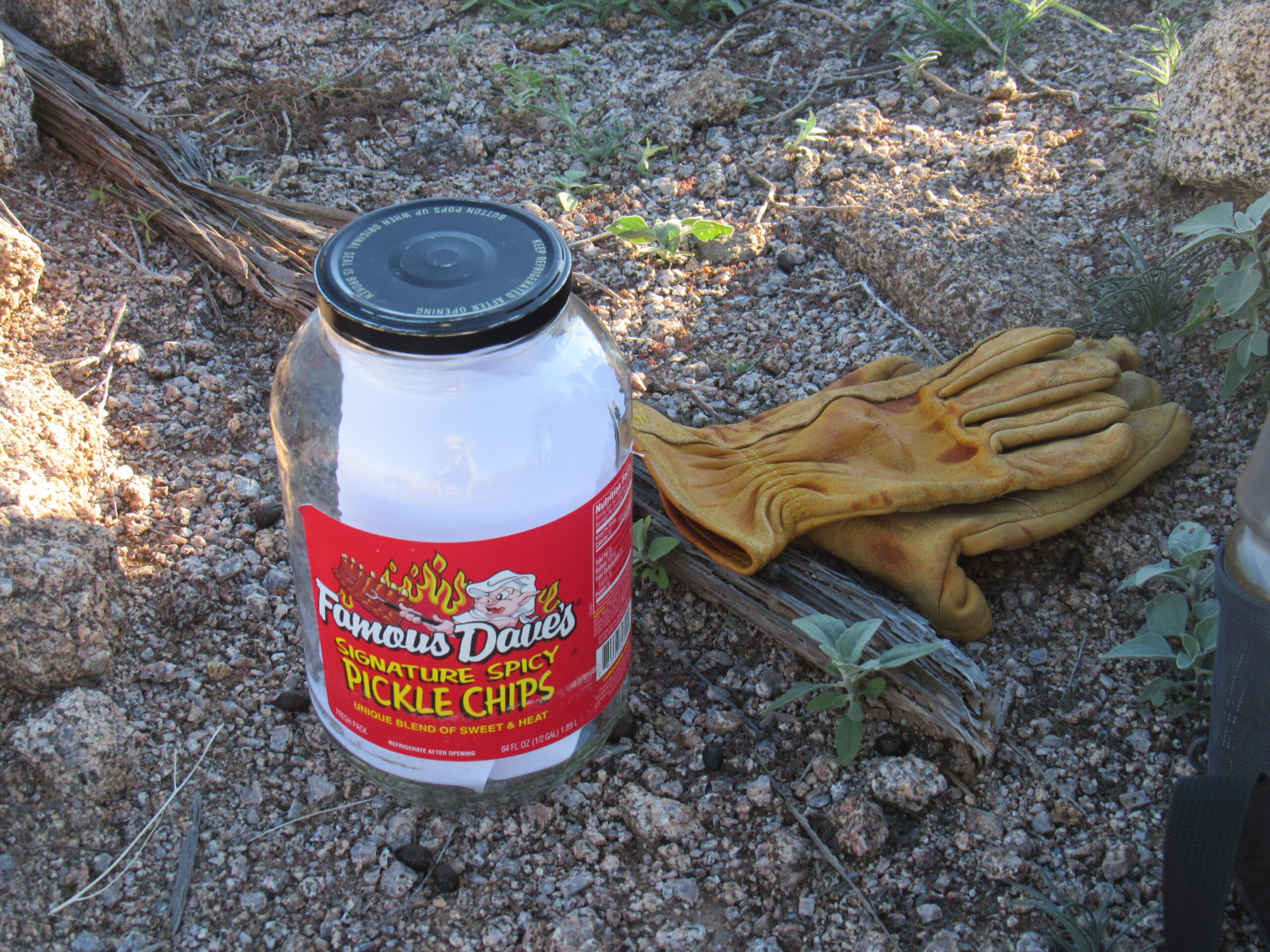
The half-gallon register.
I once worked on a project where I had to climb 400 peaks and I left registers on over 300 of them. My wife was asking her co-workers to save jars for me, and I got every shape and size imaginable. On a small mountain called Picacho Peak, about a mile south of the village of Santa Lucia on the Tohono O’odham Indian Reservation, one day I left the biggest one of all, a full gallon. It took a while to build a cairn big enough and sturdy enough to protect that one.
A California peakbagger named Richard Carey has left registers all over the desert southwest. They are legendary. Here’s one of his I encountered. They consist of nesting cans coated with a high-quality weatherproof paint, always red like this, and a tight jar inside all. This register had been placed 16 years earlier and the writing on the paper inside the jar looked fresh and newly-written.
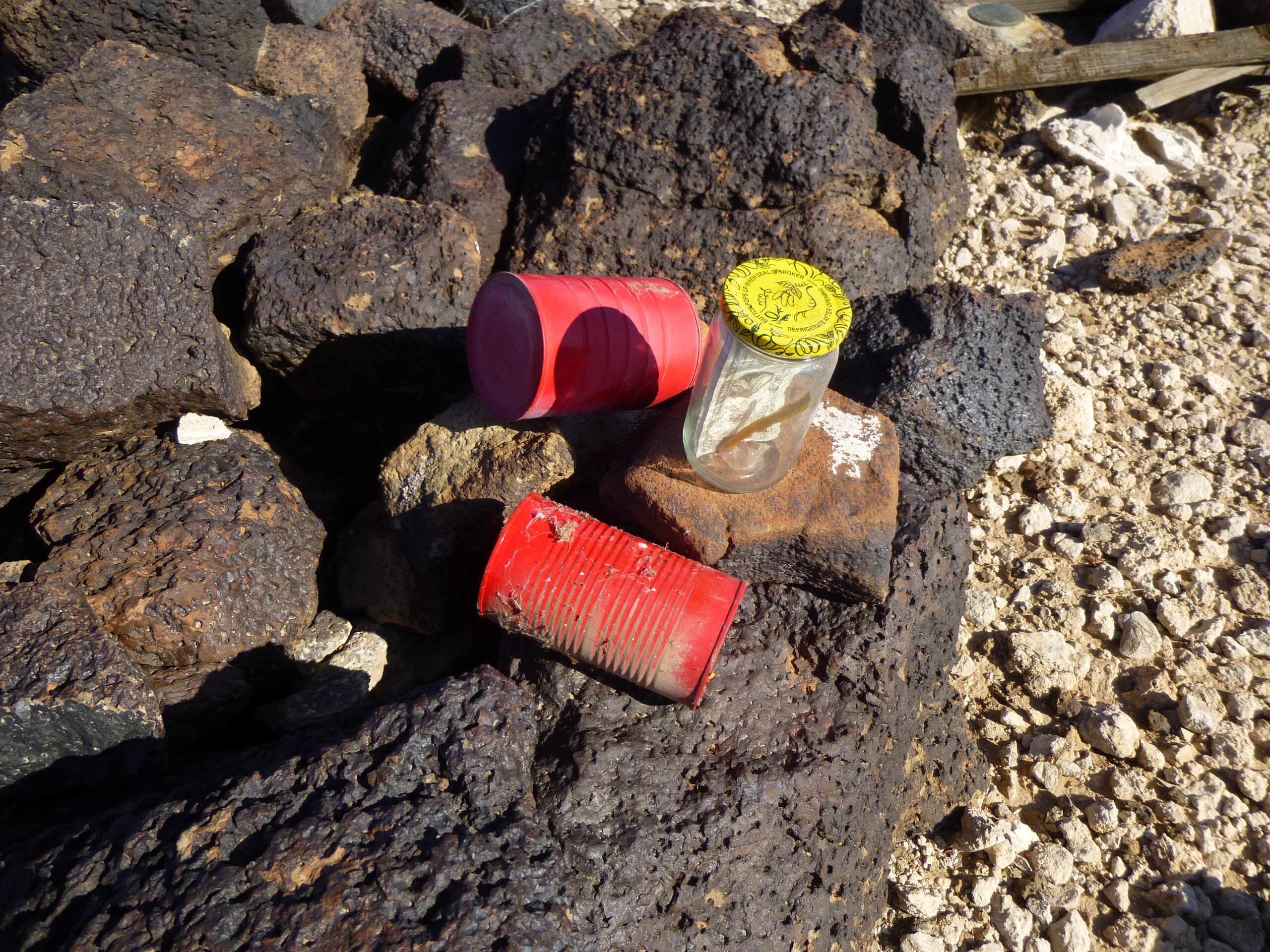
A Rich Carey register
Sometimes, if you run out of proper jars, you may have to improvise, like this one.
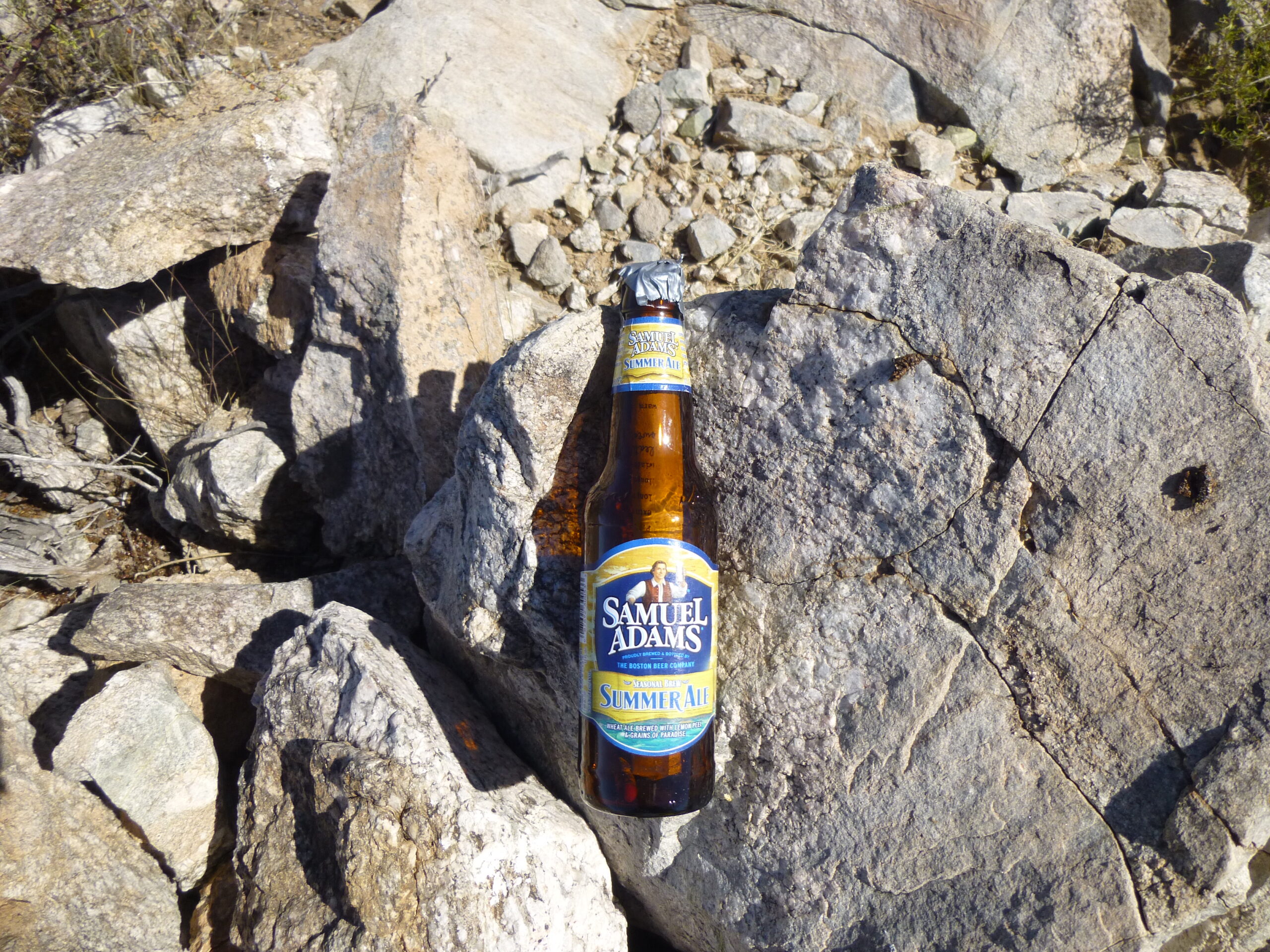
Improvised! Even with the duct tape sealing the top, it’s hard to say how long this one will last.
Something else that’s important – always write in pencil, never an ink pen. Ink soon fades and becomes illegible, whereas pencil lasts for decades. One time, atop an obscure peak in British Columbia, I found a cairn, inside of which there was an old tin, open and quite exposed to the elements. Inside it was a scrap of paper, and written on it in pencil were the names of 2 men who had climbed it on September 20, 1941. It was remarkable to see that their note had survived 36 winters and was still quite legible. It goes to show that registers written in pencil will last, while those written in ink will not. I left a better register and put their note along with mine inside it.
I’ve seen jars wrapped in duct tape – maybe they think it’ll last longer.
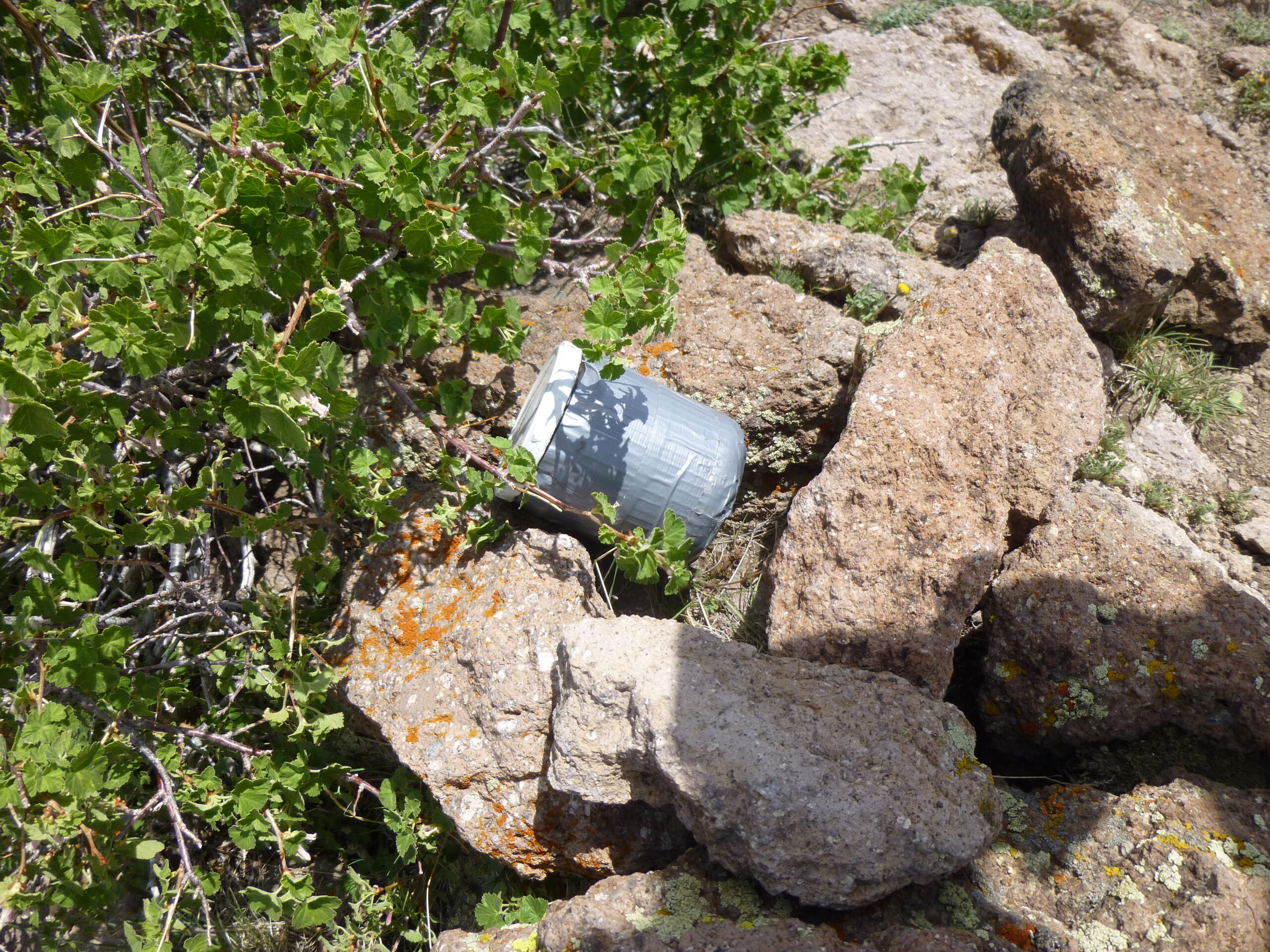
A taped jar
Probably the ultimate summit register would be the metal ammo box. These have a tight-fitting lid and are totally waterproof and weatherproof, and are most likely to be placed by a club or a government agency on an oft-climbed peak.
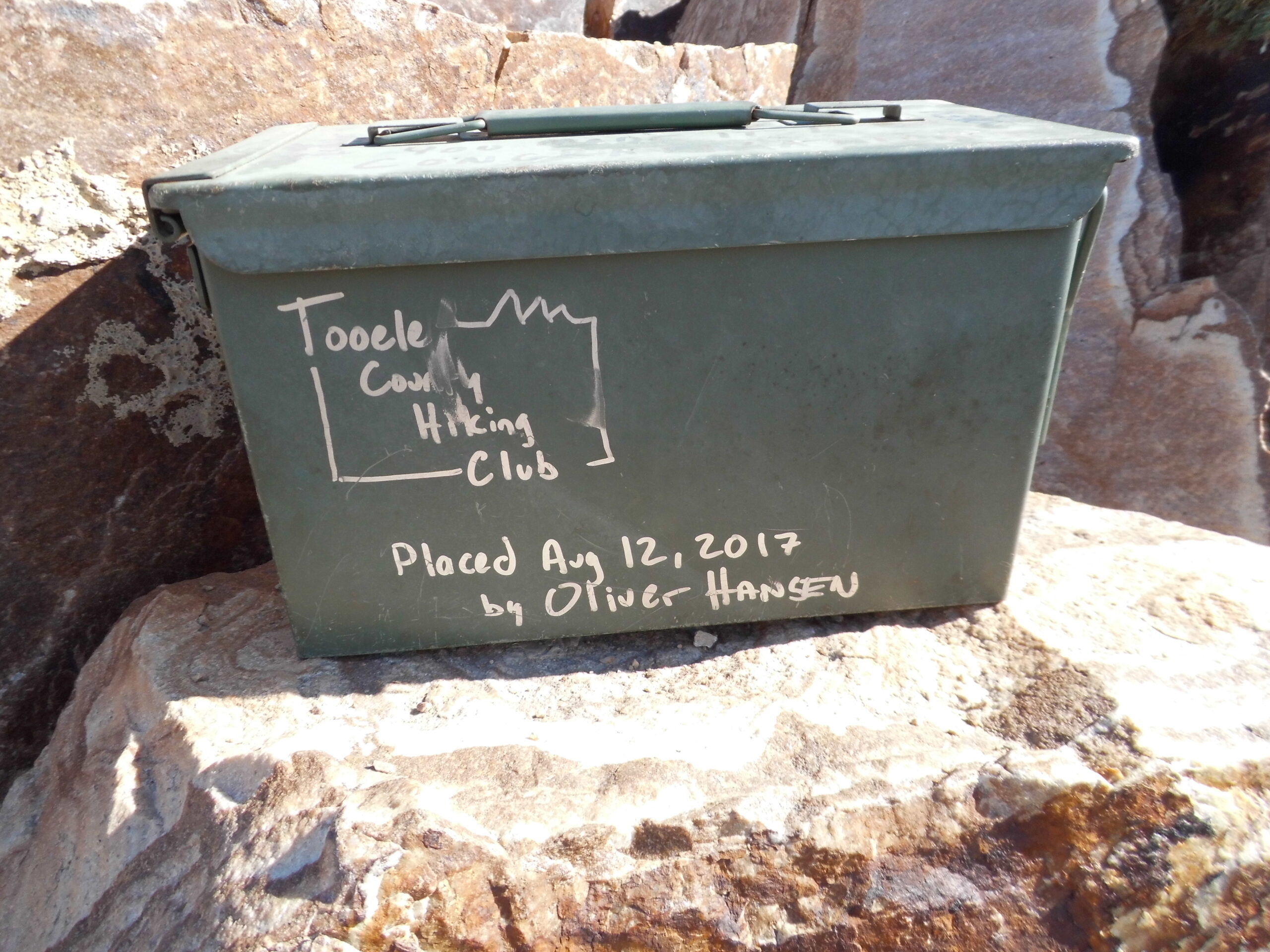
The ammunition box.
It’s always nice to step on a bare summit where there is no register, because now you get to leave one. Here, there were plenty of rocks with which to build a cairn.
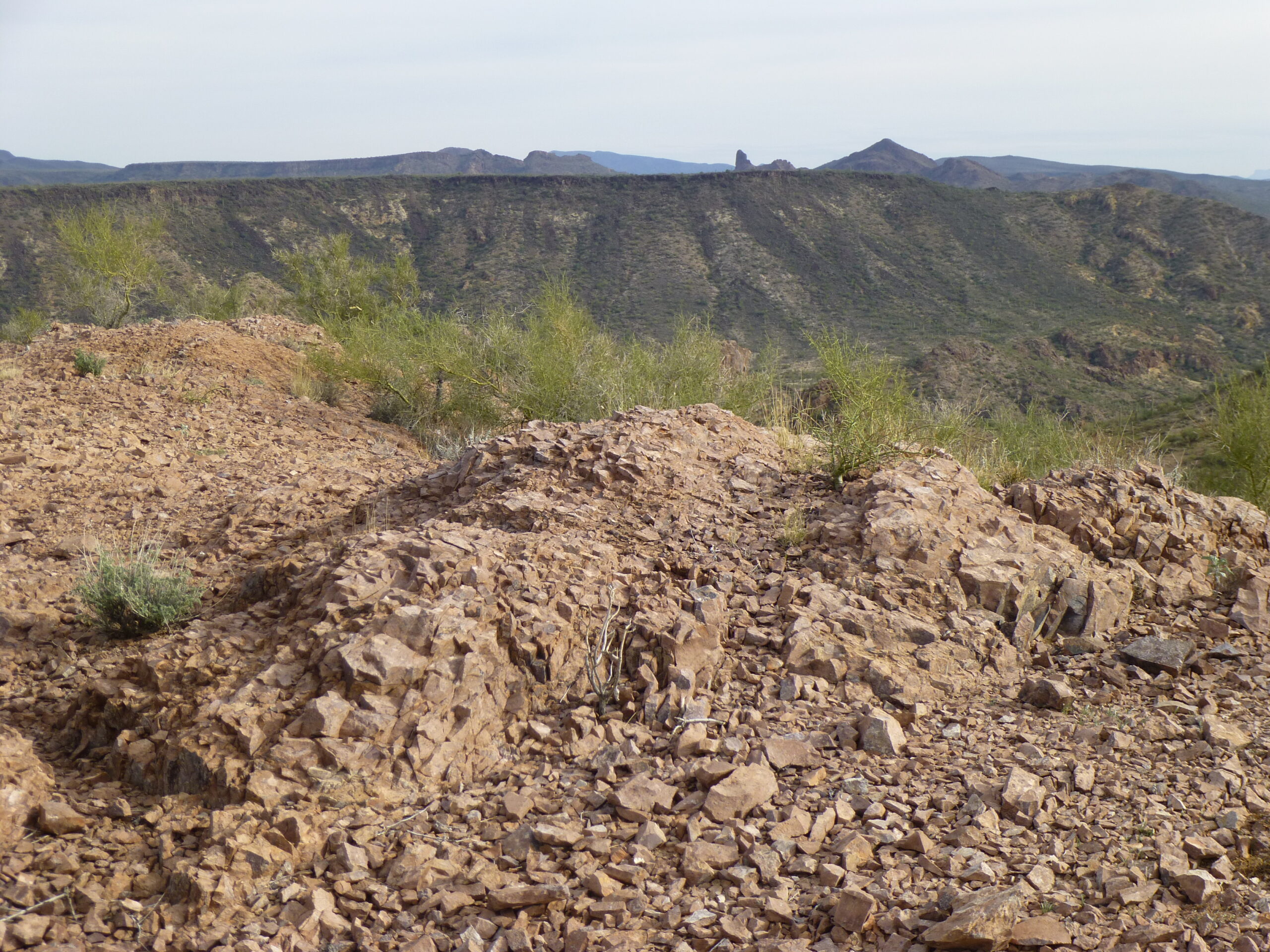
A bare summit
Here is an example of a summit which had no loose rocks with which to build a cairn. In this case, there’s no use leaving a register, as it’ll blow away or get blasted by lightning out in the open.
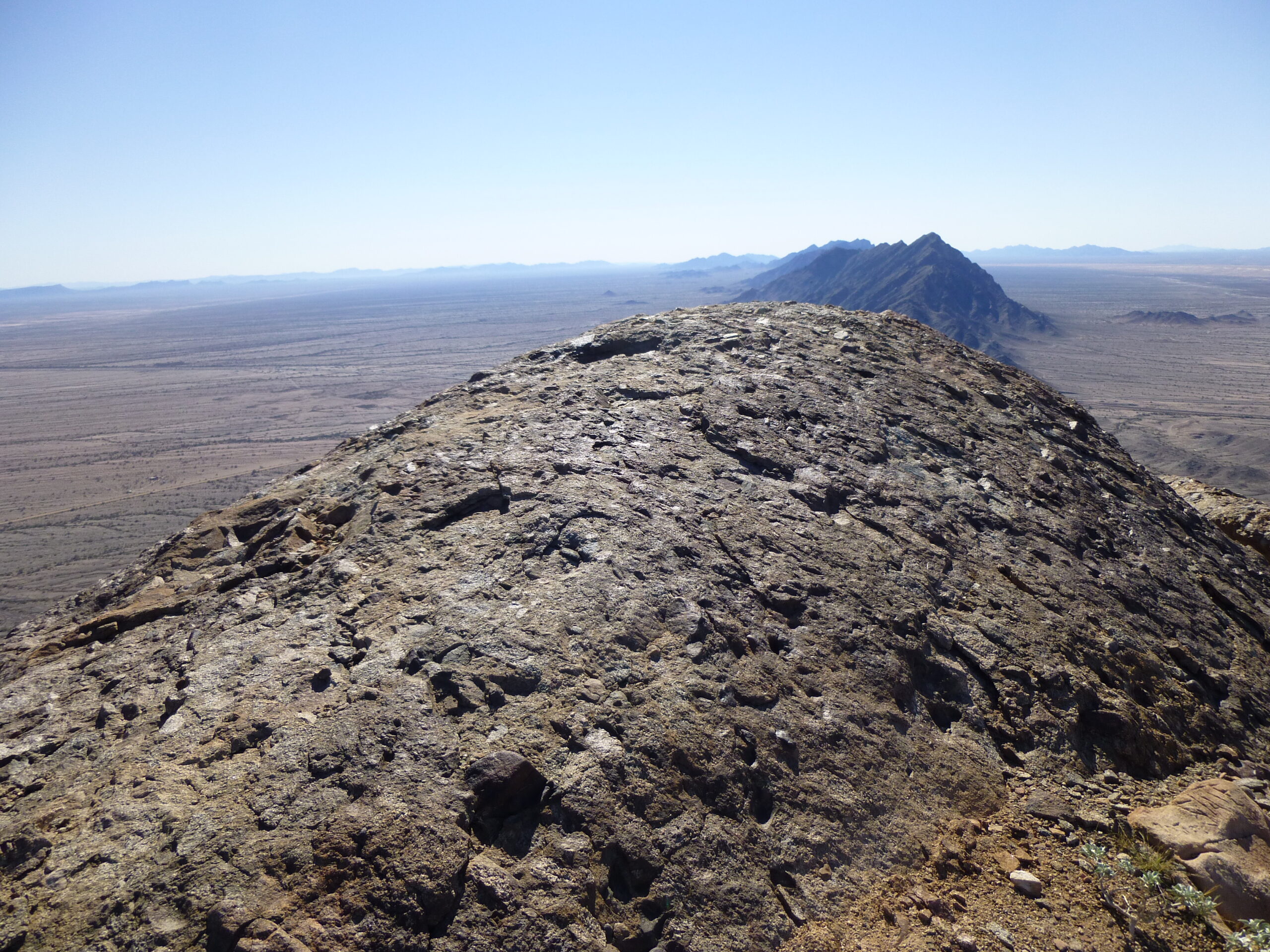
A very bald peak.
When I first started leaving summit registers, back in the 1960s, I used those small plastic containers that 35-millimeter film came in. That was a poor choice – they couldn’t withstand the weather, and would eventually crack and fall apart. Even more so here in the desert – the heat will destroy plastic, so a glass jar or a tight metal container works best. Brass tubes work well, and sometimes plastic tubes with an end that unscrews can work if it is really tight, but I’ve seen plenty of those that have failed. Here’s an example of a plastic tube that failed – moisture seeped inside and the paper within was so black, moldy and soggy that nothing could be read. The tube is the white thing on the ground to the left of the climber – its cap is yellowish and is on the ground by the tube. The inside of the tube is black with mold from the moisture that seeped in.
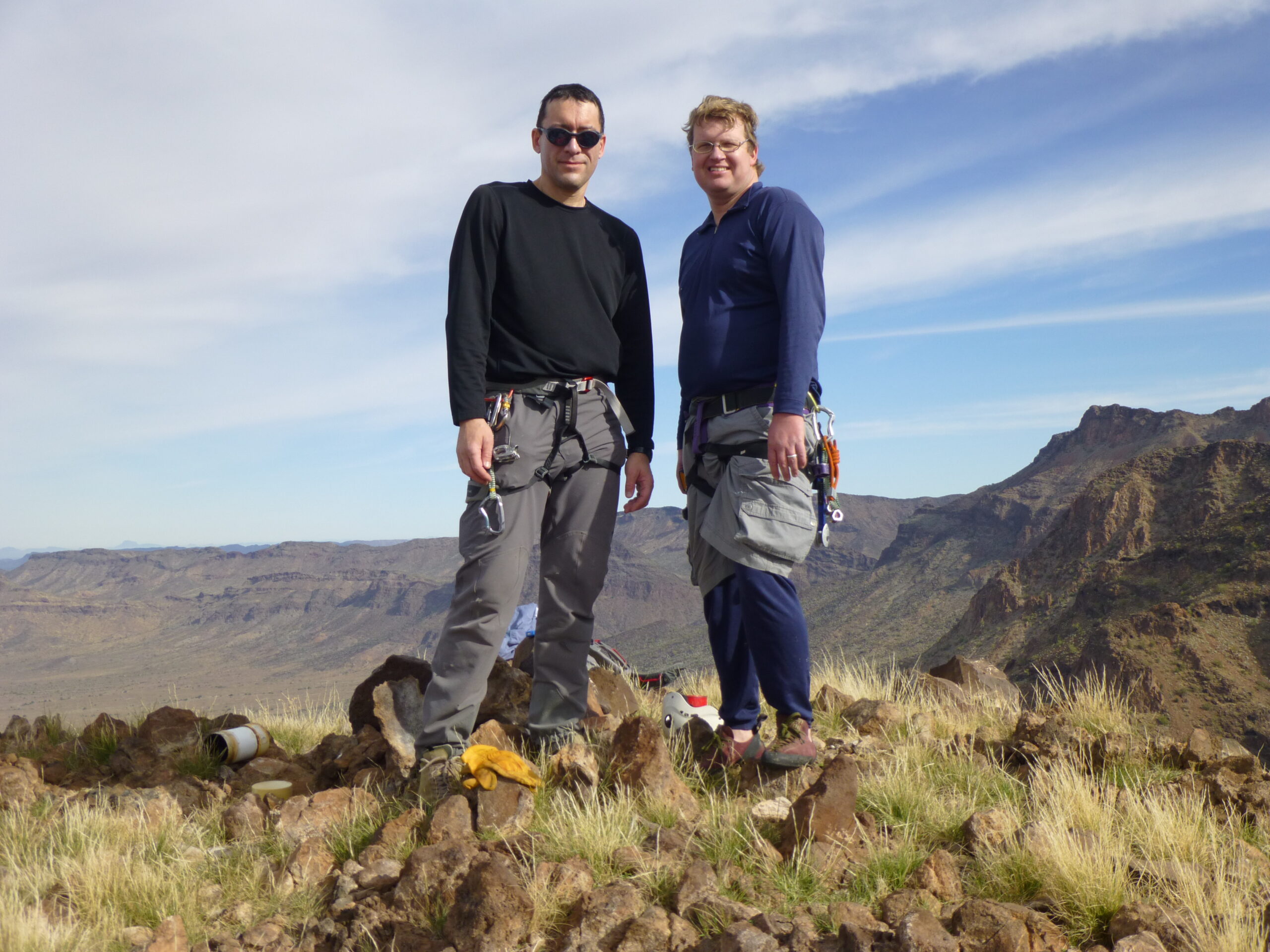
A plastic tube register
Summit registers play an important part in Search and Rescue. Some examples from California – when a climber disappears (as at Mt. Goode 2008, Palisades 2007, Brewer 2006 …) SAR even goes so far as to retrieve the registers by helicopter (North Guard/Milestone 2006). They use the registers to trace the path of the missing climber or to find people who may have seen the climber. The most famous use of registers in a search in the Sierra Nevada was the search for Walter (Peter) Starr Jr. in the Minarets, 1933. They serve as historical archives of mountaineering activity and play a critical role in search and rescue (SAR) operations by providing a timeline of a missing climber’s movements. Personally, I leave registers where there were none, and I sign in to any that I find. If something happened to me and my wife were to contact SAR so they could come looking for me, I’d feel better knowing that they could follow my path by checking into the registers I would have signed (for the peaks I’d be climbing and in what order).
They act as a “catalog of routes,” documenting first ascents and the evolution of climbing over decades. Many historical registers are now archived in libraries, such as the Bancroft Library in Berkeley. Before the advent of GPS and social media, signing a register (or using a summit stamp in some European regions) was the primary way to prove a successful climb. Nowadays, online platforms like Lists of John are popular ways to maintain summit logs and track their accomplishments.
As high-tech as the world may become, I still feel that the old-fashioned summit register plays a role in climbing today and I’ll continue to use them.