Hot Nights
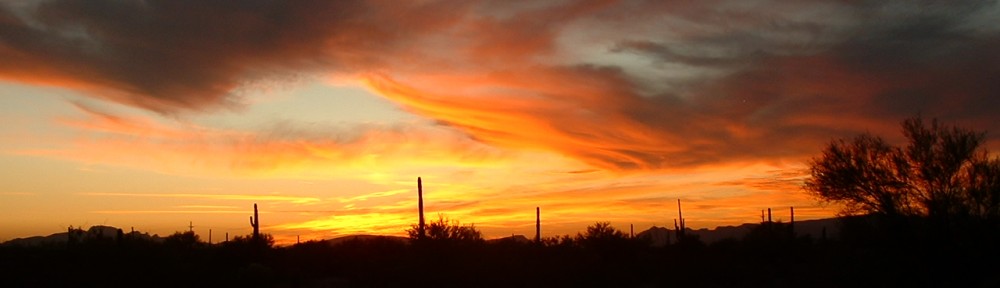
Back in the 1970s, I traveled a lot in third-world countries. Usually, I was on a tight budget, and when I did splurge on a hotel room (instead of camping) it would be something cheap. In the summer months in tropical countries, it would be hot and humid, and the hotels I chose didn’t have air conditioning. The best I could hope for would be a ceiling fan. Many were the miserable nights spent in rooms that felt like a hothouse, trying desperately to sleep while the fan whirled on its highest speed. The only relief was to take a cold shower, and usually several of them each day. Sometimes it felt better outdoors in the 90-degree heat and 100% humidity than in the hotel room.
Fording
I have only forded a river a few times, and each time I did, I always wore shoes or boots. No way was I going to try it in bare feet. If the water was murky from glacial silt, you couldn’t see the bottom, and you didn’t want to step on sharp rocks with bare feet and hurt yourself, or throw yourself off balance. I would use my ice axe to support myself by probing the bottom. Usually the water was ice-cold from glacial runoff. People have died fording rivers because they got swept away – often because the water was too deep or fast.
Unwanted Rope
One time while camped at 19,500 feet on a peak, I saw a rope lying on a nearby rock. It was nicely coiled, a brand-new 11mm climbing rope, just sitting out there in the open. Some climber must have left it there, not wanting to bother carrying it back down the mountain. I didn’t want to either, as my pack was already too heavy, so I just left it. I’m sure somebody must have taken it before long, as others passed nearby fairly often.
Close Quarters
Nine days and eight nights. That’s how long the 3 of us spent in the tent. Sure, it was designed as a 3-man tent, but with no room to spare. You could lay 3 sleeping bags out in it, but there was no room left over for anything else. Here’s how it looked from the outside.
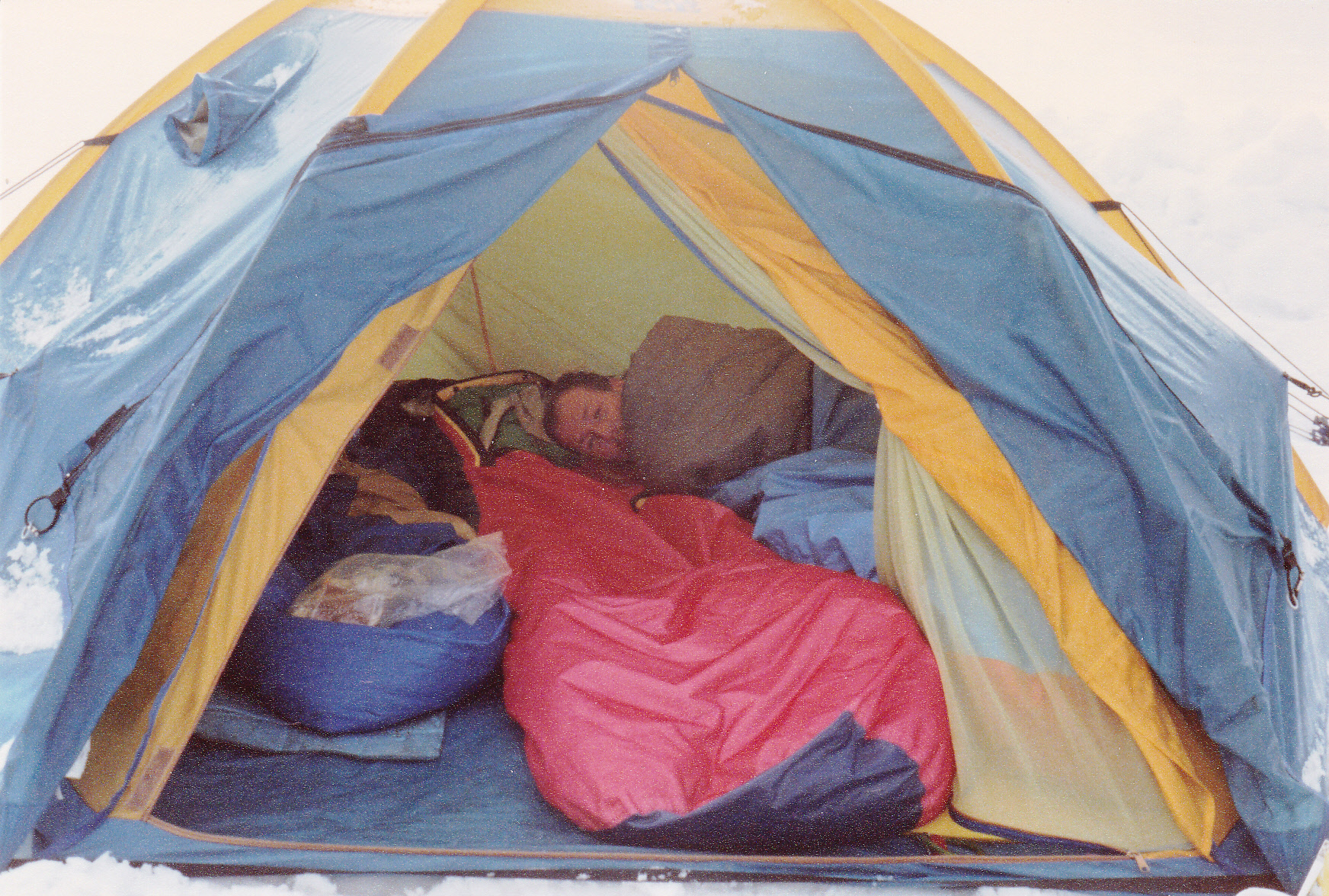
A peek inside the tent.
In those 9 days, we made 2 attempts on the face, only to be have our asses kicked in grand style – the weather just wouldn’t allow us to safely climb. Not only did we spend each of the long nights in the tent, but usually much of each day as well – it was often snowing, and this was summer! There is no doubt in my mind why the mountain is nicknamed “The Great White Fright” (no, it’s not the one in the UK). It’s surprising how being cooped up together like that for so many days, that we never ran out of things to talk about, and never once did we argue or exchange harsh words. Sadly, one of the 3 of us would perish on a challenging climb a month later.
The VW Beetle
When I was first married, in 1973, my wife’s girlfriend sold us her VW Beetle. It was a beautiful car, with a two-tone root beer paint job. It was our only car, but I soon commandeered it for climbing trips, often leaving her stuck at home. It didn’t take long to discover that, because the engine was in the rear over the driving wheels, the car had really good traction. It could claw its way up most of the logging roads in the area, even most of the worst ones. I used it more and more, racking up 50,000 hard miles in just a few years. I had a re-built engine put into it a couple of times by a local mechanic. An important item I always carried in the car was a large pair of tin snips. Sometimes the car would get into an argument with rock outcrop alongside the road and the result would be a jagged tear in a fender – I could then snip off the protruding metal and carry on. When I finally sold the car for next-to-nothing, it was a battered shadow of its former self.
Parador del Inca
That’s the name of a restaurant in the village of Puente del Inca, a last stopping place before heading off to Plaza de Mulas for the ruta normal on Cerro Aconcagua. Back in early 1990 when I was first there, it was the only game in town. All those con la intención de alcanzar la cumbre stopped at the Parador. It was a pretty cool place, where climbers from many countries sat with cold beer and overpriced fried chicken, swapping lies and exchanging dreams of a quick and easy ascent. It was always thick with cigarette smoke until the wee hours. Many left photos and greetings pinned to the walls, including the likes of Reinhold Messner. It was a place you could both love and hate – the camaraderie, the excitement, along with the ridiculous prices and enough smoke to shorten your life by several months for each evening spent there. The disgusting bathroom was accessed through the kitchen. I am grateful though that the owner let me lay out my sleeping bag for a few nights on the kitchen floor after hours (there was no other place I could afford – the one hotel was exorbitantly priced).
Thousand-Yard Stare
Have you ever heard the expression “thousand-yard stare”? Here’s a good definition I found: “The act of someone looking into the distance and appearing not to be noticing or emotionally involved with what is going on around them, typical of someone who has suffered severe emotional shock”. I’ve seen that look on climbers who’ve survived a hellish climb, and I’ve even worn the look a few times myself.
MSR Rebuild
I had a few free days at my disposal before I really started into the climb. I’d used one of those MSR stoves from the 1970s that burned every kind of fuel known to man, the kind that you could safely take with you to any country, knowing you’d be able to find some type of fuel that it would burn. I sat in the sun and took my time, taking it apart and putting it carefully back together. When I fired it up after the rebuild, it didn’t work as well as it should, the way I knew from the early days when I first bought it. I took it apart again and started over. After putting it back together that second time, all was well. If you can’t reliably melt snow at altitude to produce water for drinking and cooking, your climb could be over before it even starts.
Sleeping On Rope
I’ve read stories of climbers who were forced to bivouac overnight in places where they couldn’t lie down to sleep, where there wasn’t enough room. That happened to me and Brian Rundle one time on a wilderness climb. We ran out of daylight when we were only halfway down the mountain. We were tucked in at the base of 2 cliff faces where they met in a tight notch. The best we could do was to sit on our ropes so as to keep our sorry asses off the cold, hard, winter rock. We sat back to back, propping each other up for 14 hours, and didn’t get any sleep. There was no room to lie down because around us were openings that dropped down the face. It was a scary spot – every time I nodded off, I’d suddenly wake up with a start. When daylight arrived, Brian led us down the rest of the face with 7 carefully-executed rappels, which took us until noon to complete.
Cramped Hut
On my second trip to climb in the Andes, I teamed up with some young climbers from the city of Mendoza in Argentina. We set out on a trail, camped overnight part-way, then the next day made it up to a hut at 11,700 feet, well above tree-line. During the day, others arrived, a total of 17 of us in all. I don’t know if the hut was owned by one of the climbing clubs in Mendoza, or if it was used by scientists who did research in the range.
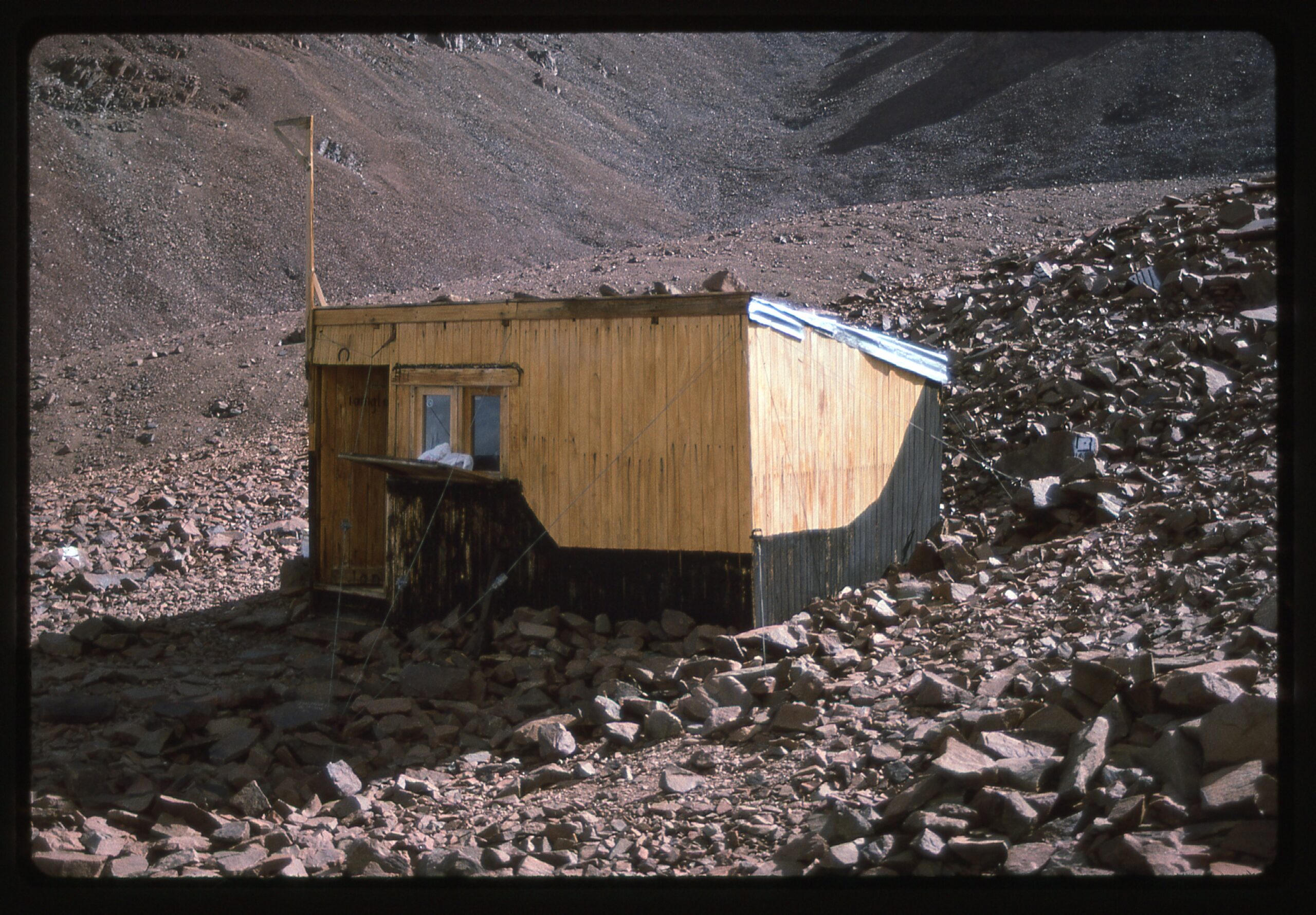
The hut.
The place was packed. As for sleeping, there were 4 small plywood platforms. The girls got those – the rest of us were crammed like sardines on the floor, anywhere you could lay your sleeping bag. I ended up on the floor directly beneath one of the platforms. There wasn’t much clearance, so it was good that I wasn’t claustrophobic. The next day I struggled to the top of a peak at 16,400 feet and made it back down to the hut. A second night was spent there, and the next day everybody descended to the lowlands and back to the city. As for me, I was plenty nauseous when I returned to the low country, the price I paid for climbing so high too quickly.
Squamish and the Bugaboos
Although I had done some peakbagging in the years 1962 to 1964, my first alpine climb didn’t come until 1965. At that point, I knew nothing about rock climbing. I didn’t know anyone who climbed on rock, so I had no one to teach me. During the summer of 1966, I made a trip into the Bugaboos. It was easy to do, as I was working in the town of Golden, BC. All you had to do was drive 46 miles south of town on Highway 95 to Brisco, and then another 27 miles west and south to the end of the road. There you were, only 3 miles from such features as Bugaboo Spire. The Bugaboos are known the world over for their beauty and technical challenges. Yes, I made a trip there, but could only gawk at what I saw in front of me. I had no skills whatsoever that would allow me to even set foot on the spires. I never returned to the Bugaboos.
The summer of 1967 found me in a lot of alpine country, and when I returned to the University of British Columbia in September, I became curious about rock climbing and decided it was time to learn the craft. The town of Squamish was only an hour away to the north, and boasted some of the finest rock climbing to be found anywhere north of California’s Yosemite Valley. I bought my first rope, and my roommate and I headed up to Squamish. I don’t know what we expected to accomplish, but I remember standing at the base of some steep rock on one of the lesser bluffs near town. It started to rain and we stood there like a couple of drowned rats, completely clueless. We didn’t even know how to start. We may have gone back there another time or two but still didn’t accomplish anything. Nobody had ever taught us how to climb.
Fast forward to the year 1977. This was my next real visit to Squamish. Brian Rundle and I spent a day there and did a climb of a route known as Deidre (5.7) – I wore a pair of borrowed Royal Robins rock-climbing shoes and Brian wore his mountain boots. That was the only roped rock climb that I ever did at Squamish.
Mt. Edith Cavell
During the summer of 1988, I spent a few months climbing in the Canadian Rockies. July 5th saw me at Mt. Edith Cavell, elevation 11,027 feet with friends Harry, Scott and Brian. We were attracted to the peak because of its beauty and the fact that it is an ultra-prominence peak, with 6,631 feet of clean prominence. We started off on the west ridge route. Harry said he wasn’t up for it, so he waited by the side of the trail for our return. It was a long day – we climbed 7,100 vertical feet over a 15-mile distance. We got our summit, though, found Harry on the way back, and starting planning for our next climb. One description of the west ridge climb is as follows: It follows a long, often loose rib system and scree slopes. Although less technical, it requires strong route-finding skills to avoid getting “cliffed out” on the descent.
Our route was also the usual descent route for harder routes on the mountain. In later years, I went to try the classic east ridge route with a Bostonian I had met, but we were unsuccessful due to poor weather.