Cobblestone Road
We were a hundred miles south of the border, deep into Sonora, on the way to our next objective. A sketchy dirt road headed east from the paved highway we were on. A simple sign saying “Micro Ondas” told us we were at the right place. A spot on the map with the name of Las Bateas was our next objective, and we found it okay – it was a simple ranch house, which appeared to be abandoned..
Once through an unlocked gate, the dirt road changed dramatically beyond the house – it became paved with a sort of rough cobblestone. Not like the nice cobblestones you see carefully laid in the streets of old cities, or in driveways of some newer homes, but, rather, stones of irregular shape and size. The road surface had been carefully prepared and the stones all laid by hand. It caught us by surprise, as we didn’t expect to find anything like that out there. This wonderful road dropped down through a major drainage and climbed up the other side for a mile or so, then climbed steeply up in a series of switchbacks. It went for miles, sometimes gently and at other times so steeply that it required a slow crawl in 4wd. It was both exciting and puzzling at the same time to be on this road. Why was it paved with these stones? I mean, this was way out in the middle of nowhere, it was beyond beyond. Someone had gone to enormous expense to pave it, and the only thing that made sense was that the entity that owned the microwave towers on the ridge was behind it. There were a few spots where the road was eroded on its side and some of the pavers had fallen away, but for the most part it was in really good shape. Along the road, we passed a couple of ranch houses which seemed unoccupied. As we approached the ridge crest, the cobblestones ended and a decent dirt road continued. A few more miles brought us to a saddle at 6,025′ elevation. It was about 10:30 AM. We estimated that the cobblestone paving ran for about 5 or 6 miles in total.
The Measure of Risk
Another clever quote from a climber, written about 100 years ago, is as follows:
The highest form of adventure is the blending of the mental with the physical. It may be a mental adventure to sit in a chair and think out some new invention, but the perfect adventure is that in which the measure of achievement is so great that life itself must be risked. A life so risked is not risked uselessly, and sacrifice is not to be measured in terms of lucre.
Tinkling of Icicles
In the summer of 1981, I met up with 2 friends in Jasper National Park in the Canadian Rockies. Our goal – Mount Columbia, the highest point in Alberta and the second-highest peak in the Rockies. Our first day was spent climbing up to the high country of the Columbia Icefield, a gain of about 2,500 vertical feet and a trudge of 5 miles, until we camped for the night. Bright and early the next morning, we covered the remaining 7 miles to reach a saddle at 8,800 feet. Our chosen route was the east face, an all-ice route. We roped up, the 3 of us, and started up the face.
We climbed steadily and had reached 11,300 feet elevation, a thousand feet below the summit. I had pushed the shaft of my ice axe up to its head into the snow on the steep slope, about 45 degrees at this point. It met with no resistance, and I heard the sound of chunks of ice tinkling as they fell deep inside the mountain. My blood froze. I very cautiously backed down a few feet, moved laterally several feet, then pushed my ice axe in up to its hilt. The same thing happened again, no bottom to my probe. I was scared. Once more I moved over and tried again, with the same result. Ross and Phil were below me on the slope, still tied in to the rope. They asked me what was happening, and I explained, They said it was my call as to how to proceed. I told them I was standing at the lip of a large hidden crevasse, size unknown, and that it was unnerving me badly. Trying to pull someone out of a crevasse is risky and difficult, and I didn’t want to be the test subject up on a slope like this, far from help. That’s it, Lads, we’re done. Even though we were within striking distance of the summit and above most of the steep part, we retreated. Back down to the bottom of the face by 3:00 PM, we began the interminable slog back to camp, arriving at 8:00 PM – we had been gone 13 1/2 hours. In the years that followed, we often wondered if we shouldn’t have tried the south ridge, a route with more rock but a little farther away, probably more of a sure thing, but hindsight is always 20-20, isn’t it?
Fixed Rope
Brian was leading us along a highly broken ridge towards an obscure summit we had named “The Ugly Sister”. The place was outrageous – the climbing was challenging with moves to 5.8 and, to put it into his words, there was a heart-stopping drop of at least 1,300 vertical feet of unbroken air off the north side. At one point, we reached a nasty notch in the ridge. In order to save time on the return, Brian fixed a rope down into the notch, a drop of about 80 feet. Well, in good time, we made it to the summit, left a register, and headed back down the ridge the way we’d come. To quote Brian:
The rope was fixed, so we could Jumar out of the notch if needed, but I was sure that was going to get messy and gobble up time. The Ugly Sister would have her way with us if we attempted this, I’m sure. It looked as if I could climb out and that’s just what we did. The exposure was there, the moves were hard to protect (in fact we had to abandon a #2 Trango cam that got stuck) but the holds were great, and in short order I was up and DM was soon cleaning the pitch. It went maybe as hard 5.7.
Passing Out
The highest I’ve ever climbed was just about to 23,000 feet above sea level. I spent a couple of weeks climbing other peaks, higher and higher, until I felt ready for a climb up to that 23,000-foot summit. It went well, I made it to the summit and, other than a slight headache, felt fine on top of the peak. I got to thinking about what it really meant to be at that elevation, though, and read a series of articles written by physiologists, doctors who specialize in sports medicine, and other experts on the effects of altitude on the human body. Here is what I learned.
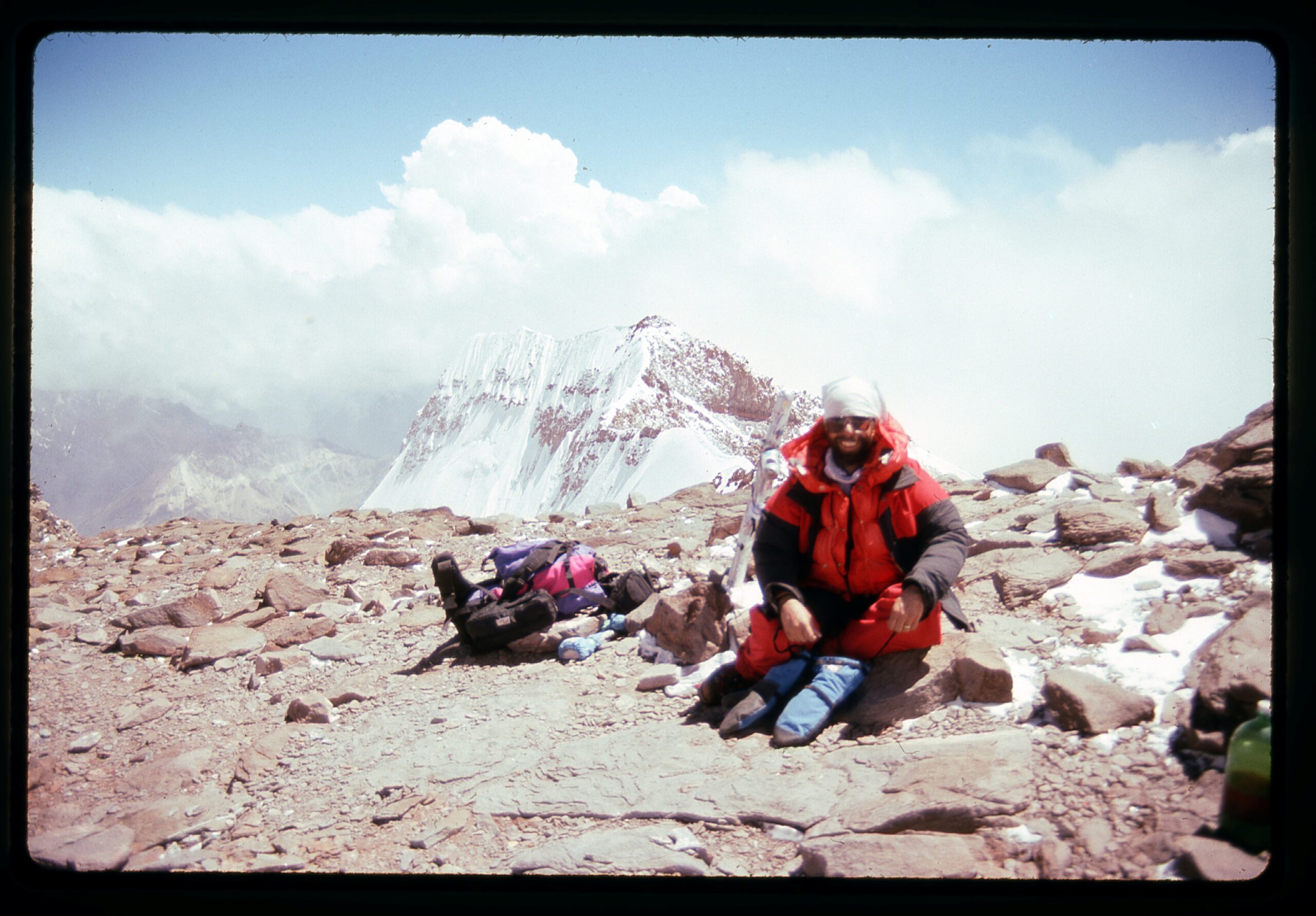
Me on top of the peak.
If you took someone who had not taken any time to acclimatize to high altitude, let’s say someone living down in the lowlands in the city, and could instantly put them on top of a peak at 23,000 feet, here’s what would happen – in 3 to 5 minutes, they would pass out; in about 20 minutes, death would follow. How could such a thing happen?
The percentage of oxygen in the air (approximately 21%) remains the same regardless of altitude. However, since up high there are fewer total air molecules, there are also fewer oxygen molecules available per breath at higher altitudes. So in effect, instead of enjoying the 21% available at sea level, you would only have 8.7% up at 23,000 feet. Such a person would find themself gasping for breath before they passed out. By gradually climbing higher and higher, your body has a chance to make more red blood cells – that allows you to take advantage of what little oxygen is in that thinner air way up high, and that’s what allows climbers to perform at high elevations.
Cold Feet
Back in 1990, I climbed a mountain in South America. I was wearing a pair of double boots made by Galibier, the Makalu model. These were considered state-of-the-art at the time and had been worn by climbers on big cold climbs all over the world for years. It was a bitterly cold morning when I found myself heading for the summit. As the sun rose, I was at 22,000 feet when I realized that my feet were starting to freeze. At first I wondered it that were even possible in my spiffy boots, the best that money could buy. As time passed, there was no doubt that my feet were getting colder. I stopped in a spot out of the wind and started stamping my feet. I kept it up for probably 15 or 20 minutes until the tingling in my feet told me that circulation was returning and that things had returned to normal. Whew! Only then did I continue up the mountain.
Andinista
I like how the Spanish language has a specific word for someone who climbs in the Andes, that being “andinista”. They also have a specific word for someone who climbs in the Alps, that being “alpinista”. They don’t have a specific word for someone who climbs in the Rocky Mountains (at least that I know of), but just refers to such a climber as “un montañista de las Montañas Rocosas.” Hey, that works for me, as montañista means “mountaineer”.
List Finish
Back in 1985, I wondered how many mountain ranges there were in Arizona. Nobody had ever figured it out, so I spent months poring over every topographic map sheet that covered the state. What a job, and what a lot of work it was, requiring hundreds of hours. Finally, it was done. The next logical thing to do was to go out and climb to the highest point of every one of the 193 ranges. It took me about 4 years to do them all. It felt great to finish the list and to celebrate with a few friends. However, I soon realized that the journey itself, the map study, the planning, the driving and the ascents – all of that was more rewarding than the actual act of finishing the list. I felt somewhat depressed for weeks afterwards. Perhaps I should have felt elated to have it done, but I didn’t. I felt like something was missing in my life. The project had so occupied me for those years that once it was completed, it was like a big part of my life was gone, like there was an empty hole I couldn’t fill. Sure, I got over it and moved on but it took a while. It took 9 more years before a second person, Dave Jurasevich, completed the list.
Mexican Jail
In the summer of 1970, I was driving through Mexico with my friend Dan. We were only several days into the country when, one sultry night, we found ourselves out in the countryside near Los Mochis. We met an American guy, Jim, who was quite a character. He had been living in the country for a few years, generally up to no good and hanging out with people of dubious character. He regaled us with wild stories as we sat around smoking stuff and living la vida loca into the early morning hours. His best story was this one, though.
His friend had been driving through a rural part of Mexico one night after dark. This is generally considered unwise. As he was passing through a village, he struck and killed an elderly woman dressed in dark clothing who was walking along the edge of the road. He didn’t even see her until it was too late. Horrified, he stopped, and before he knew it a number of the villagers had quickly gathered at the scene of the accident, as did the local police. He was taken into custody and locked up in the nearby jail. His biggest mistake was that he had no insurance (Americans who intend to drive down into Mexico are advised to buy a liability insurance policy that will cover them for their stay in the country). That was when his real troubles began. He had to hire a sleazy Mexican lawyer to represent him at an exorbitant cost. He had to have his family back in the States send him money to pay the lawyer and even pay for him to get enough proper food while in jail. He spent months locked up while the lawyer tried to negotiate a payment that would satisfy the deceased’s family, the jailers and the lawyer. This all occurred in the late 1960s. Finally, several tens of thousands of dollars later, he was freed and got his sorry ass back north to the States as fast as he could go.