Thursday, August 8, 1991
Even if you’ve never been there, it’s quite likely that many of you have heard of Lake Louise. It’s been a favored tourist spot for over a hundred years, ever since the Canadian Pacific Railway built the hotel in 1913 in the heart of the Rocky Mountains. The hotel was first conceived by the railway at the end of the 19th century, as a vacation destination to lure moneyed travelers into taking trains and heading west. By the time airplanes and automobiles had displaced the trains, it had gained sufficient renown to have a life of its own. The natural areas around the hotel were incorporated into Banff National Park, which has been declared a World Heritage Site by UNESCO. The 8-storey hotel is open year-around, has 539 rooms and is pretty pricey – I checked online and couldn’t find a room for less than a thousand bucks a night, and that’s US dollars – way too rich for my blood.
I had visited Lake Louise as far back as 1961, then several times in 1965 and 1966, again in 1968, and quite a few more times during the 1970s and 1980s. Usually short visits, but in 1991 my longest visit occurred. Climber friend Brian Rundle and his friend Harry, both from Toronto, flew in to Calgary, then rented a car and made the short drive to Lake Louise. Earlier in the day, I had also driven from Calgary to the village of Lake Louise and I went straight to the campground. Much to my chagrin, they had just given out the last campsite. It was Thursday, August 8th, and we wanted to spend a week there. I pleaded with them, telling how far we had come, and miraculously they found one last campsite that they rented to me. I happily paid them the $10.75 Canadian dollars, the asking price, and breathed a sigh of relief. There were 206 nice campsites there and I was grateful to snag one. I see that now, in 2026, the fee is $34.00 per night.
I went to the nearby village, bought and mailed a few postcards, then went back to the campsite and set up 2 tents. I also paid for a second night. I cooked some supper on my MSR mountaineering stove, but it worked poorly and was very sooty. Then I discovered why – it still had the kerosene jet in it from a previous trip abroad. Once it had cooled down, I cleaned it well and then put in a jet that would burn white gas – what a difference that made, and it worked perfectly after that. I prepared my day pack for the next morning, chatted for a while with my neighbors from Wisconsin, then left a note for Brian and Harry at the campground entrance. I turned in and slept soundly. They showed up at 11:45 – after a bit of talk, we soon were all sleeping well.
Friday, August 9, 1991
We were up at 6:30 AM and got ready for a big day. We drove the short 9 miles to Moraine Lake and parked by the fancy new lodge that had been built in 1988. At 8:30 we set out on a trail, up and through Larch Valley. The weather was perfect, and before long we arrived at Sentinel Pass, elevation 8,566 feet. The 3 of us continued up to 9,700 feet, where Harry decided to go no further. Brian and I continued, but he soon left me in his dust and arrived at the summit of Mt. Temple – I arrived an hour later, and it had taken me 6 1/2 hours to reach the top. I had climbed Temple 4 years earlier and at that time, there was a lot more snow on the route. The mountain stands at 11,627 feet and is an ultra-prominence peak. Our route, the southwest ridge, is just a moderate scramble, and is the route of the first ascent, done way back in 1894. Mt. Temple was the first one of the iconic 11,000-ers to be climbed in the Canadian Rockies, and there were dozens of people on the mountain the day we climbed it. Brian descended before me, and I found him waiting with Harry 2,000 feet below – we 3 descended the rest of the way together. When we drove back to our campsite, we were greeted by 2 beautiful German girls camped in the campsite next to us. We ate something, then went into town for a beer. Our climb of Mt. Temple had us climbing 5,700 vertical feet over a distance of 11 miles.
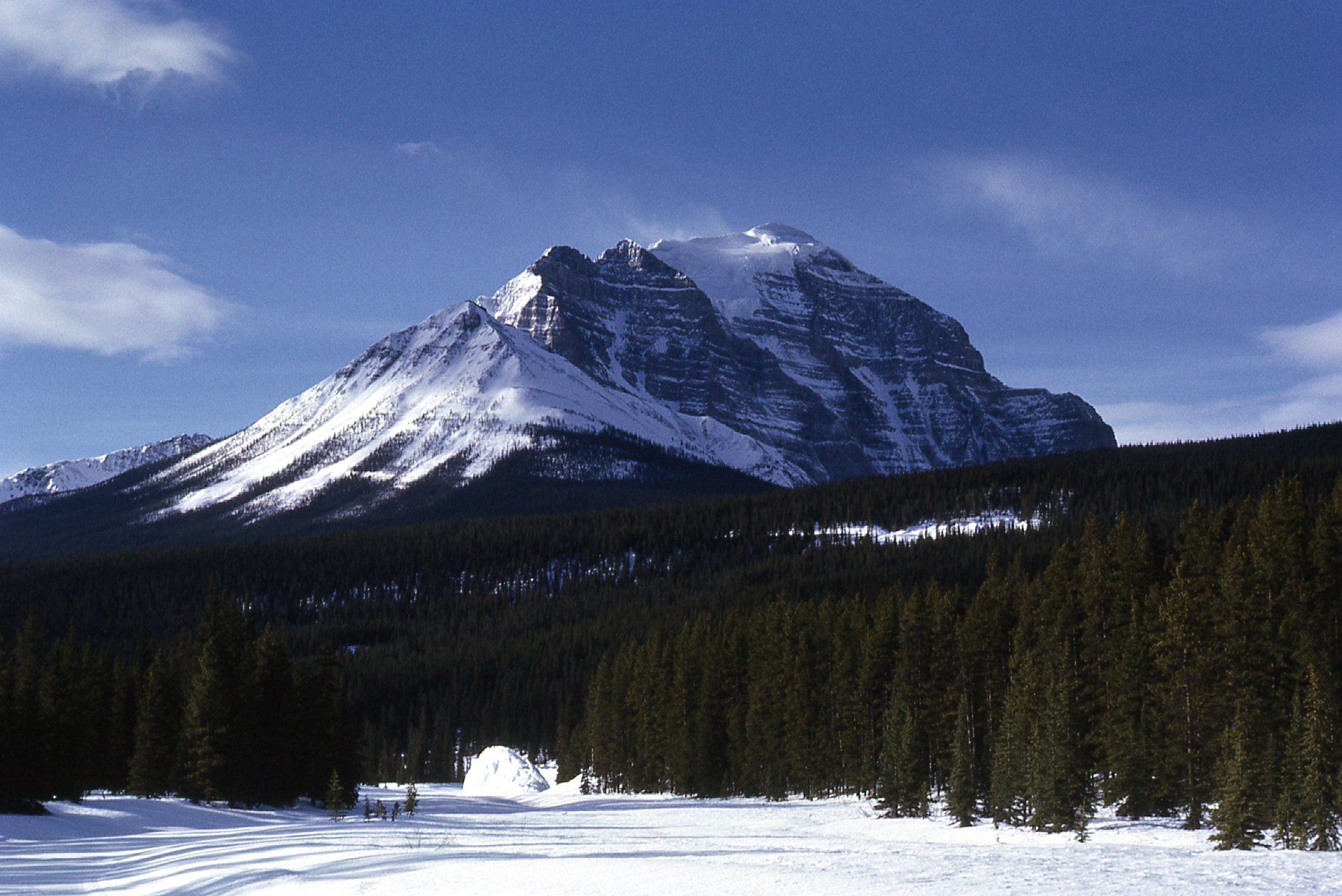
Looking south to Mt. Temple in the winter, taken back in 1972. Our route was on the other side.
Saturday, August 10, 1991
We awoke to the sound of thunder, and since the weather was threatening, we were in no rush to go anywhere. Our campground has hot showers, and we took advantage of that to get cleaned up. Finally, we prepared day packs and drove up to Lake Louise, elevation 5,740 feet, where we set out on a well-maintained trail. The weather was mixed, kind of on-again, off-again. Up we went, to Mirror Lake at 6,827 feet, then on to Lake Agnes, at 7,022 feet. There, we sat at the teahouse (built in 1909) on the east shore of the lake. While sipping Earl Grey tea, we hand-fed the chipmunks and the Clark’s nutcrackers for quite a while. Sooner or later, we had to climb something and so we walked the trail along the north side of the lake and climbed to 7,450 feet to the summit of The Beehive.
After we climbed The Beehive, we then went on to climb a higher peak called Devil’s Thumb, at 8,050 feet. We took our time, lazing about in the sunny weather, solving many of the world’s problems. We left and went back down to Lake Louise, and by then it was pouring rain. Back at our campsite, we cooked a meal, then went to a place called the Outpost for some beer-drinking. It had been a decent day, dodging the weather – we had climbed 2,550 feet over a distance of 11.4 miles.
Sunday, August 11,1991
When we woke up this morning, the weather looked very uncertain. I had spent the summers of 1965 and 1966 working in the Rockies, and this pattern of crappy weather was reminiscent of what I saw back then. I still believe today that summers in the Canadian Rockies are a real crapshoot when it comes to weather – a lot of climbers have traveled there only to go away disappointed. So, we decided to drive the 31 miles to the town of Banff where we joined the throngs of tourists and browsed the shops for souvenirs.
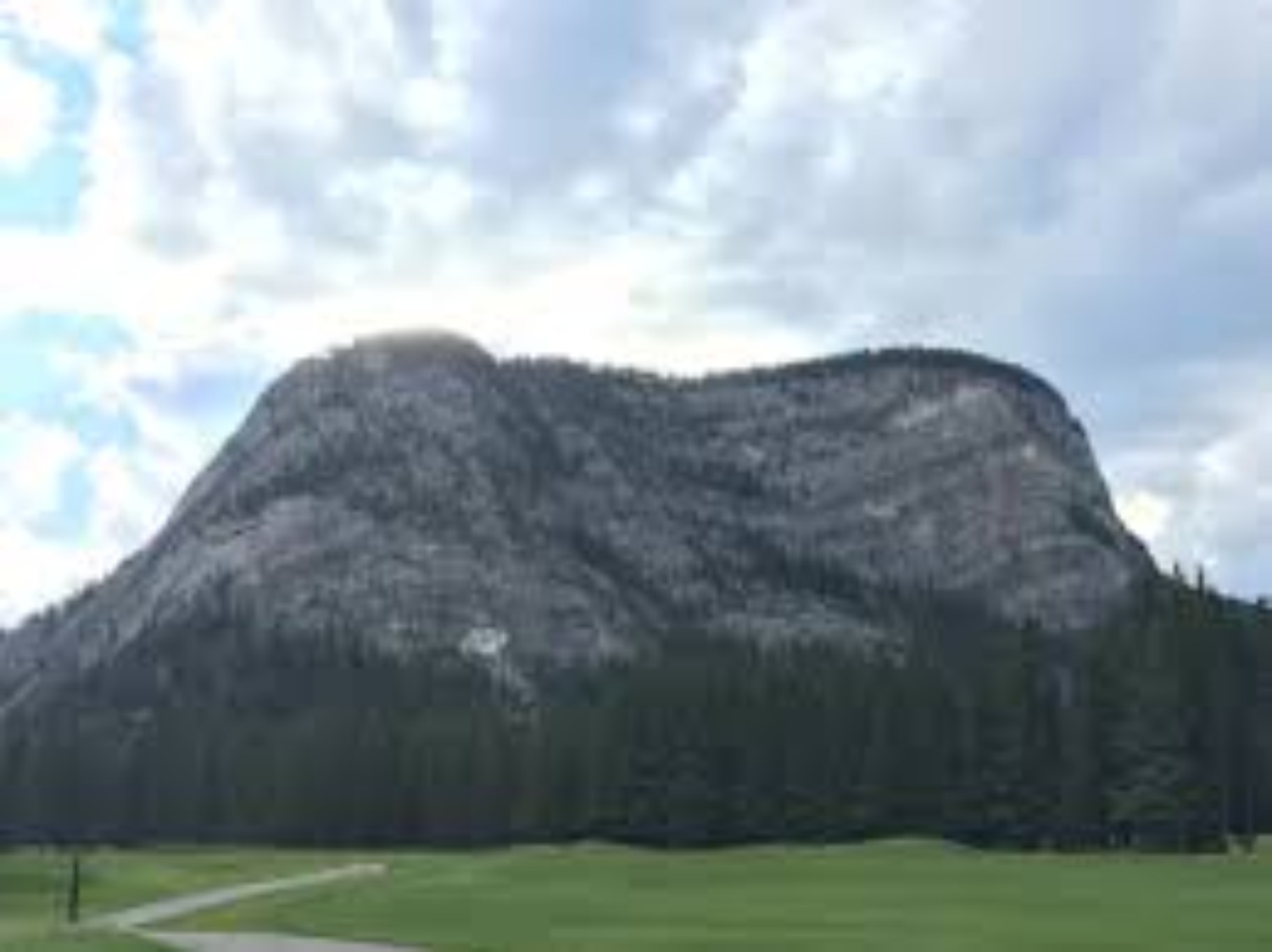
Tunnel Mountain
The weather was holding, so we found the start of the trail up Tunnel Mountain (elevation 5,545′) right next to the town. It was a thousand-foot climb to the top on a good trail with plenty of other folks, and a round-trip of 2.9 miles. Great views of Banff from the top. We spent a while up there, then headed back down the trail to town. In search of more ideas, we drove 20 miles back west towards Lake Louise but then headed down into Kootenay National Park where we talked to a park ranger. He informed us that on the north side of Stanley Peak, the east end route up the peak would be a good choice for our next outing. Unfortunately, the long-term forecast for the week is rain, and more rain. Hmmm, we’d have to play it by ear. Back to our campground we went, got cleaned up a bit – then, after we ate, up the hill to a place called The Trading Post. We sat and had a cup of tea while a band tuned up, then down the hill again to the visitor center. Nice place, we had a good look around, and while there met a couple from Madrid – they were happy to have someone to speak with in Spanish. That was about the height of the evening’s entertainment. Back at our campsite, we made plans. This would be our 4th night here. Maybe tomorrow would be a rest day, but it’s hardly like we need one.
Monday, August 12,1991
What a day! We slept in late and when I woke up my eye was really bothering me, so much so that the guys drove me over to the small medical clinic where I met with the British doctor who manned the place. He tested my vision, froze my eye, put in a fluorescent dye, then determined that I had a scratch across my cornea but above my iris. He put antibiotics in it and then taped a patch over it. Aarrgh! Now I can for sure be a member of the West Luton Long-John-Silver Impersonators. Back at the campsite, we spent the day listening to tapes such as John Mayall and Monty Python on the stereo in my car. By 7:00 PM, I took off the patch. The doctor had given me some antibiotics and Brian put some in my eye. We then made our nightly pilgrimage into the village and sat in a nice non-smoky bar and drank tea (we were quite the party animals, right?). Also, we made another stop at the beautiful new visitor center, which is quite spectacular. I wore sunglasses all day, even in the dark. Brian put more drops in my eye before bed. I’ve been sleeping well every night, as the campground is nice and quiet.
Tuesday, August 13,1991
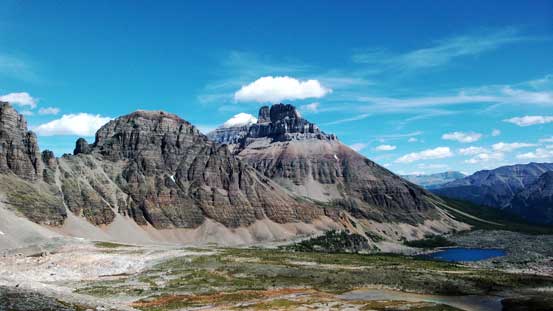
After sleeping in late, we got day packs ready and drove back up to Moraine Lake. We moved well up the trail into Larch Valley, but once there, left the main trail and headed on a lesser trail over to the southeast ridge of Eiffel Peak (elevation 10.119 feet). The route went up through scree, talus and a bit of good rock. The weather was threatening the whole time. Harry decided to stop about 800 feet below the summit, and Brian stayed with him. I made it to the top in 30 minutes from where I left them, and when I returned, Brian decided to head for the summit himself , and a guy and a girl who had caught up to us also went for the top. While we waited, Harry said to me that he’d had it, that summits scare him too much, that he’s going to stick to hiking on trails. Once Brian returned, we leisurely walked back down to Moraine Lake. That evening, Harry bought us supper at the pub. My eye feels 100% better. The forecast for today had been a 40% chance of precipitation, and not a drop fell on us. Tomorrow is a 30% chance, but we hope it goes well, as we have a big day planned. The climb of Eiffel Peak involved 4,000 feet of climbing over 8.2 miles. This next photo is courtesy of climber Steven Song. Eiffel Peak is the dark summit in the center of the photo, with the puffy white cloud above it.
Wednesday, August 14, 1991
It was hard to fall asleep so early last night, but still I slept fairly well. Before I knew it, my alarm was going off at 3:15 AM. Brian and I got up right away, dressed, ate and drove up to the Lake Louise parking lot. We were moving on foot by 4:00 AM. The weather was unsettled – we could see a few stars. There is a paved pathway that goes all the way down to the end of the lake, about 2.5 KM. It was easy to walk with no headlamp, as the floodlights on the exterior of the Château were so bright. However, once past the end of the lake, the trail began to climb right away – we needed our headlamps for the next 3 KM until we reached the tea house at the Plain of Six Glaciers. Once there, it was still dark, so we waited an hour and 15 minutes for more light. Also, it was raining and we hoped it would stop. Well, the rain stopped and daylight arrived. Quite chilled, we set out again – the trail ended 1.3 KM later.
We climbed down the steep lateral moraine of the lower Victoria Glacier and on to the bare ice. It wasn’t difficult to work up the glacier to where permanent snow covered the ice. Here, we roped up – I led, and we went up a long way until we stopped to eat and rest. There were no crevasse problems to that point. Brian led from there, but before we had gone much further, a huge crevasse blocked our path. We couldn’t see any way across it – with just crampons and ordinary ice axes, we had no ice tools with us to try anything technical. Then the clouds lowered and we found ourselves completely socked-in. We couldn’t see any way to proceed – we were at 9,000 feet, and about 600 feet below the Abbott hut, which was our next objective. Then the heavens opened and it started to pour rain – that was it, we were done, and back down we went. We retraced our steps and arrived back at the tea house, completely soaked.

This rustic structure had stood since 1924, and catered to those touristy folk who chose to walk up from Lake Louise to get a closer look at the amazing mountain scenery. By the time we arrived in the drizzle, we looked like a couple of drowned rats. Normally, we would have just kept going on past and back to our vehicle, but for some reason that day we decided to stop. They had a nice, open-air veranda – we took off our packs and plunked ourselves down in a couple of chairs. We stripped off our sodden rain gear and laid it over the railing to dry. A young waitress came over to see if we’d like to order something. For some reason, neither of us had so much as one thin dime with us that day. Brian turned on the charm to see if he could bum a pot of tea, but she wasn’t having any of it. Too bad, because by now the idea of hot tea seemed quite appealing. Before long, a couple arrived and sat at a nearby table. After waiting until they had ordered, I sauntered over and struck up a conversation. Basically, it was a sob story about how we’d started off in the wee hours to climb Mount Victoria but poor conditions had forced us back, and now we found ourselves at the tea house – cold, hungry and tired. All our cash was sitting in the car back at the parking lot, so we found ourselves in an awkward situation. Was there some way we could borrow some money from them – strictly a loan, of course – and pay them back when we all returned to the vehicles? They seemed a bit uncomfortable with my pitch, but in the end kindly agreed to give us some cash – five dollars, in fact. They insisted there was no need to pay them back. So, on the kindness of strangers, we enjoyed hot tea and ate some of the food we’d brought for the climb. After we left that fine establishment in the pouring rain, Brian and I couldn’t help but wonder if they simply wanted to get us out of their hair and not have to deal with us any further, avoiding a meeting down at the parking lot with such scruffy-looking guys. In any case, we were grateful. I had worn Brian’s Makalus on the glacier but my old runners on the trails. Before long, we met Harry, coming up to meet us. We all walked together to the Chalet parking lot in the rain. Our attempt on Mt. Victoria involved 3,850 feet of climbing over a distance of 12.2 miles.
We went back to our campsite – everything was soaked, and it even rained at camp. After changing into dry clothes, we relaxed, ate, then went to the Village for a beer (our usual nightly routine). The way I’m feeling right now, I don’t want to come back to the Canadian Rockies for a while – the mountains are great, but the weather is lousy.
Thursday, August 15, 1991
We slept in. The weather looked okay. We packed everything up and gave up our campsite after 7 nights. We drove up to the Château parking lot and prepared for another day of climbing. I decided to do an anorak climb (where everything I needed for the day was stuffed in the many pockets of my Gore-tex rain jacket). The 3 of us headed up a trail together and arrived at a saddle. From there, I whizzed up to the summit of Fairview Mountain (elevation 9,003 feet) in 41 minutes, then went back down to the saddle. Harry and Brian had gone up nearby Saddle Mountain (elevation 7,986 feet) and I went up the trail to it, meeting them both near the summit. We descended together to the saddle, then down again to the cars. Our outing had us climbing 3,770 feet over 7.8 miles. We drove back down to the Village. Harry left in the rental car back to Calgary, Brian caught a Greyhound for the coast, and I (after paying 3 dollars for a shower) bought a few snacks and drove out of the mountains and began the 1,700-mile drive back to Tucson.
As I mentioned earlier, the summer weather in the Canadian Rockies can be notoriously unsettled and unpredictable. The Lake Louise trip in 1991 would prove to be my last significant trip to the area, and even though much of our weather was pretty shitty, we did manage to get a bit of nice climbing done.